Barbados
Updated
Population
282,623
2025 · World Bank
GDP
$8.02B
2025 · World Bank
GDP per capita
$28,365
2025 · World Bank
Area
430 km²
mledoze/countries reference dataset
Capital
Bridgetown
Median age
39.4 yrs
2025 · UN WPP
Location
- Capital
- Bridgetown
- Region
- Central America and the Caribbean
- Subregion
- Caribbean
- Area
- 430 km²
- Languages
- English
Leadership
- Head of state
- Sandra Mason
- In office since November 30, 2021
- Head of government
- Mia Mottley
- In office since May 25, 2018
Wikidata (CC0), checked August 11, 2026. Frozen Factbook mirrors still list the officeholders of January 2026.
Then and now
The CIA World Factbook stopped updating in January 2026. This is what has changed since its final edition.
| Indicator | Factbook, final edition | Current | Change |
|---|---|---|---|
| Population | 304,1392024 | 282,6232025 | -7.1% |
| GDP (nominal) | $7.17B2024 | $8.02B2025 | +11.9% |
| Inflation rate | -0.5%2024 | 0.8%2025 | +1.3 pp |
Trends since 2000
World Bank, World Development Indicators (CC BY 4.0).
6 facts about Barbados
- 01 Barbados ranks 182 of 238 in population, with 282,623 people as of 2025.
- 02 Its economy produced $8.02B in 2025, or $28,365 per person.
- 03 Barbados has no land borders.
- 04 Population has grown 8% since 2000, from 262,063 to 282,623.
- 05 Prices sit at about 110% of United States levels (World Bank PPP data, 2025).
- 06 70% of the population uses the internet (2024).
Reference
- Languages
- English
- Currency
- Barbadian dollar (BBD)
- Calling code
- +1246
- Internet TLD
- .bb
- Demonym
- Barbadian
- ISO codes
- BB · BRB · 052
The Factbook archive 139 fields · 11 categories
The complete World Factbook entry for Barbados: 139 fields and 229 sub-entries across 11 categories, kept whole as historical reference. A United States Government work in the public domain, reflecting data as of the final January 2026 edition; the live figures above supersede the fast-moving numbers in it. Last CIA update: January 8, 2026.
Introduction 1 field
- Background
- Barbados was uninhabited when first settled by the British in 1627. Enslaved Africans worked the sugar plantations established on the island, which initially dominated the Caribbean sugar industry. By 1720, Barbados was no longer a dominant force within the sugar industry, having been surpassed by the Leeward Islands and Jamaica. Slavery was abolished in 1834. The Barbadian economy remained heavily dependent on sugar, rum, and molasses production through most of the 20th century. The gradual introduction of social and political reforms in the 1940s and 1950s led to independence from the UK in 1966. In the 1990s, tourism and manufacturing surpassed the sugar industry in economic importance. Barbados became a republic in 2021, with the former Governor-General Sandra MASON elected as the first president.
Geography 17 fields
- Location
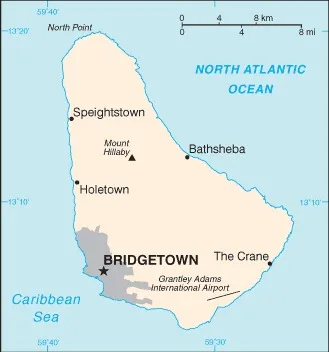
- Caribbean, island in the North Atlantic Ocean, northeast of Venezuela
- Geographic coordinates
- 13 10 N, 59 32 W
- Map references
- Central America and the Caribbean
- Area
- total: 430 sq kmland: 430 sq kmwater: 0 sq km
- Area - comparative
- 2.5 times the size of Washington, D.C.
- Land boundaries
- total: 0 km
- Coastline
- 97 km
- Maritime claims
- territorial sea: 12 nmexclusive economic zone: 200 nm
- Climate
- tropical; rainy season (June to October)
- Terrain
- relatively flat; rises gently to central highland region
- Elevation
- highest point: Mount Hillaby 336 mlowest point: Atlantic Ocean 0 m
- Natural resources
- petroleum, fish, natural gas
- Land use
- agricultural land: 23.3% (2023 est.)agricultural land: arable land: arable land: 16.3% (2023 est.)agricultural land: permanent crops: permanent crops: 2.3% (2023 est.)agricultural land: permanent pasture: permanent pasture: 4.7% (2023 est.)forest: 14.7% (2023 est.)other: 62.1% (2023 est.)
- Irrigated land
- 50 sq km (2012)
- Population distribution
- most densely populated country in the eastern Caribbean; approximately one third of the population lives in urban areas
- Natural hazards
- infrequent hurricanes; periodic landslides
- Geography - note
- easternmost Caribbean island
People and Society 31 fields
- Population
- total: 304,139 (2024 est.)male: 146,587female: 157,552
- Nationality
- noun: Barbadian(s) or Bajan (colloquial)adjective: Barbadian or Bajan (colloquial)
- Ethnic groups
- African descent 92.4%, mixed 3.1%, White 2.7%, East Indian 1.3%, other 0.2%, unspecified 0.3% (2010 est.)
- Languages
- English (official), Bajan (English-based creole language, widely spoken in informal settings)
- Religions
- Protestant 66.4% (includes Anglican 23.9%, other Pentecostal 19.5%, Adventist 5.9%, Methodist 4.2%, Wesleyan 3.4%, Nazarene 3.2%, Church of God 2.4%, Baptist 1.8%, Moravian 1.2%, other Protestant 0.9%), Roman Catholic 3.8%, other Christian 5.4% (includes Jehovah's Witness 2.0%, other 3.4%), Rastafarian 1%, other 1.5%, none 20.6%, unspecified 1.2% (2010 est.)
- Age structure
- 0-14 years: 16.6% (male 25,273/female 25,284)15-64 years: 67% (male 100,328/female 103,536)65 years and over: 16.3% (2024 est.) (male 20,986/female 28,732)
- Dependency ratios
- total dependency ratio: 49.2 (2024 est.)youth dependency ratio: 24.8 (2024 est.)elderly dependency ratio: 24.4 (2024 est.)potential support ratio: 4.1 (2024 est.)
- Median age
- total: 42.2 years (2025 est.)male: 40.3 yearsfemale: 42.5 years
- Population growth rate
- -0.42% (2025 est.)
- Birth rate
- 8.02 births/1,000 population (2025 est.)
- Death rate
- 11.96 deaths/1,000 population (2025 est.)
- Net migration rate
- -0.3 migrant(s)/1,000 population (2025 est.)
- Population distribution
- most densely populated country in the eastern Caribbean; approximately one third of the population lives in urban areas
- Urbanization
- urban population: 31.4% of total population (2023)rate of urbanization: 0.46% annual rate of change (2020-25 est.)
- Major urban areas - population
- 89,000 BRIDGETOWN (capital) (2018)
- Sex ratio
- at birth: 1.01 male(s)/female0-14 years: 1 male(s)/female15-64 years: 0.97 male(s)/female65 years and over: 0.73 male(s)/femaletotal population: 0.93 male(s)/female (2024 est.)
- Maternal mortality ratio
- 35 deaths/100,000 live births (2023 est.)
- Infant mortality rate
- total: 15.1 deaths/1,000 live births (2025 est.)male: 11.1 deaths/1,000 live birthsfemale: 8.1 deaths/1,000 live births
- Life expectancy at birth
- total population: 79 years (2024 est.)male: 76.3 yearsfemale: 81.8 years
- Total fertility rate
- 1.24 children born/woman (2025 est.)
- Gross reproduction rate
- 0.62 (2025 est.)
- Drinking water source
- improved: total: total: 98.5% of population (2022 est.)unimproved: total: total: 1.5% of population (2022 est.)
- Health expenditure
- Health expenditure (as % of GDP): 8.1% of GDP (2021)Health expenditure (as % of national budget): 8.7% of national budget (2022 est.)
- Physician density
- 2.96 physicians/1,000 population (2022)
- Hospital bed density
- 5.7 beds/1,000 population (2020 est.)
- Sanitation facility access
- improved: total: total: 100% of population (2022 est.)unimproved: total: total: 0% of population (2022 est.)
- Obesity - adult prevalence rate
- 23.1% (2016)
- Alcohol consumption per capita
- total: 9.94 liters of pure alcohol (2019 est.)beer: 3.66 liters of pure alcohol (2019 est.)wine: 1.36 liters of pure alcohol (2019 est.)spirits: 4.75 liters of pure alcohol (2019 est.)other alcohols: 0.17 liters of pure alcohol (2019 est.)
- Tobacco use
- total: 6.2% (2025 est.)male: 11.4% (2025 est.)female: 1.5% (2025 est.)
- Currently married women (ages 15-49)
- 57.2% (2021 est.)
- Education expenditure
- Education expenditure (% GDP): 3.6% of GDP (2024 est.)Education expenditure (% national budget): 14.2% national budget (2025 est.)
Environment 10 fields
- Environmental issues
- pollution of coastal waters from waste disposal by ships; soil erosion; illegal solid-waste disposal
- International environmental agreements
- party to: Biodiversity, Climate Change, Climate Change-Kyoto Protocol, Climate Change-Paris Agreement, Comprehensive Nuclear Test Ban, Desertification, Endangered Species, Hazardous Wastes, Law of the Sea, Marine Dumping-London Convention, Marine Dumping-London Protocol, Ozone Layer Protection, Ship Pollution, Wetlandssigned, but not ratified: none of the selected agreements
- Climate
- tropical; rainy season (June to October)
- Land use
- agricultural land: 23.3% (2023 est.)agricultural land: arable land: arable land: 16.3% (2023 est.)agricultural land: permanent crops: permanent crops: 2.3% (2023 est.)agricultural land: permanent pasture: permanent pasture: 4.7% (2023 est.)forest: 14.7% (2023 est.)other: 62.1% (2023 est.)
- Urbanization
- urban population: 31.4% of total population (2023)rate of urbanization: 0.46% annual rate of change (2020-25 est.)
- Carbon dioxide emissions
- total emissions: 1.348 million metric tonnes of CO2 (2023 est.)from coal and metallurgical coke: 2 metric tonnes of CO2 (2023 est.)from petroleum and other liquids: 1.284 million metric tonnes of CO2 (2023 est.)from consumed natural gas: 64,000 metric tonnes of CO2 (2023 est.)
- Particulate matter emissions
- 9.8 micrograms per cubic meter (2019 est.)
- Waste and recycling
- municipal solid waste generated annually: 174,800 tons (2024 est.)percent of municipal solid waste recycled: 10.6% (2022 est.)
- Total water withdrawal
- municipal: 20 million cubic meters (2022 est.)industrial: 6.2 million cubic meters (2022 est.)agricultural: 54.8 million cubic meters (2022 est.)
- Total renewable water resources
- 80 million cubic meters (2022 est.)
Government 25 fields
- Country name
- conventional long form: noneconventional short form: Barbadosetymology: the name is the plural of the Spanish word barbado and means "the bearded ones," which could refer either to the beard-like leaves of the island's fig trees or to the beards of Carib inhabitants
- Government type
- parliamentary republic; a Commonwealth realm
- Capital
- name: Bridgetowngeographic coordinates: 13 06 N, 59 37 Wtime difference: UTC-4 (1 hour ahead of Washington, DC, during Standard Time)etymology: originally named Indian Bridge in 1628 for a bridge built beside Carlisle Bay, then called St. Michael's Town until the 19th century; now named after a bridge built over the Constitution River that flows through the center of the city
- Administrative divisions
- 11 parishes and 1 city*; Bridgetown*, Christ Church, Saint Andrew, Saint George, Saint James, Saint John, Saint Joseph, Saint Lucy, Saint Michael, Saint Peter, Saint Philip, Saint Thomas
- Legal system
- English common law; no judicial review of legislative acts
- Constitution
- history: adopted 22 November 1966, effective 30 November 1966; Constitution (Amendment) (No. 2) Bill, 2021 establishes Barbados as a republic and revokes the earlier Order in Councilamendment process: proposed by Parliament; passage of amendments to constitutional sections such as citizenship, fundamental rights and freedoms, and the organization and authorities of the branches of government requires two-thirds majority vote by the membership of both houses of Parliament; passage of other amendments only requires a majority vote of both houses
- International law organization participation
- accepts compulsory ICJ jurisdiction with reservations; accepts ICCt jurisdiction
- Citizenship
- citizenship by birth: yescitizenship by descent only: yesdual citizenship recognized: yesresidency requirement for naturalization: 5 years
- Suffrage
- 18 years of age; universal
- Executive branch
- chief of state: President Jeffrey Davidson BOSTIC (since 30 November 2025)head of government: Prime Minister Mia MOTTLEY (since 25 May 2018)cabinet: Cabinet appointed by the president on the advice of the prime ministerelection/appointment process: president elected by an electoral college of both Houses of Parliament for a 4-year renewable term; following legislative elections, the president usually appoints the leader of the majority party or leader of the majority coalition as prime minister; the prime minister recommends the deputy prime ministermost recent election date: 7 October 2025election results: Jeffrey Davidson BOSTIC elected as the country's second presidentexpected date of next election: NA
- Legislative branch
- legislature name: Parlement de Barbade (Parliament of Barbados)legislative structure: bicameral
- Legislative branch - lower chamber
- chamber name: House of Assemblynumber of seats: 30 (all directly elected)electoral system: plurality/majorityscope of elections: full renewalterm in office: 5 yearsmost recent election date: 1/19/2022parties elected and seats per party: Barbados Labour Party (BLP) (30)percentage of women in chamber: 26.7%expected date of next election: January 2027
- Legislative branch - upper chamber
- chamber name: Senatenumber of seats: 21 (all appointed)scope of elections: full renewalterm in office: 5 yearsmost recent election date: 2/4/2022percentage of women in chamber: 33.3%expected date of next election: February 2027
- Judicial branch
- highest court(s): Supreme Court (consists of the High Court with 8 justices) and the Court of Appeal (consists of the High Court chief justice and president of the court and 4 justices; Caribbean Court of Justice is the final court of appealjudge selection and term of office: Supreme Court chief justice appointed by the president on the recommendation of the prime minister and opposition leader of Parliament; other justices appointed by the president on the recommendation of the Judicial and Legal Service Commission, a 5-member independent body consisting of the Supreme Court chief justice, the commission head, and presidential appointees recommended by the prime minister; justices serve until mandatory retirement at age 65subordinate courts: Magistrates' Courts
- Political parties
- Alliance Party for Progress or APP
Barbados Labor Party or BLP
Democratic Labor Party or DLP - Diplomatic representation in the US
- chief of mission: Ambassador Victor Anthony FERNANDES (since 18 September 2024)chancery: 2144 Wyoming Avenue NW, Washington, DC 20008telephone: [1] (202) 939-9200FAX: [1] (202) 332-7467email address and website:
[email protected]
https://www.foreign.gov.bb/embassies-high-commissions-and-permanent-missions/consulate(s) general: Miami, New York - Diplomatic representation from the US
- chief of mission: Ambassador (vacant); Chargé d'Affaires Karin B. SULLIVAN (since January 2025); note - also accredited to Antigua and Barbuda, Dominica, Grenada, Saint Kitts and Nevis, Saint Lucia, and Saint Vincent and the Grenadinesembassy: Wildey Business Park, St. Michael BB 14006, Barbados, W.I.mailing address: 3120 Bridgetown Place, Washington DC 20521-3120telephone: (246) 227-4000FAX: (246) 431-0179email address and website:
[email protected]
https://bb.usembassy.gov/ - International organization participation
- ACP, ACS, AOSIS, C, Caricom, CDB, CELAC, FAO, G-77, IADB, IBRD, ICAO, ICCt, ICRM, IDA, IFAD, IFC, IFRCS, ILO, IMF, IMO, Interpol, IOC, ISO, ITSO, ITU, ITUC (NGOs), LAES, MIGA, NAM, OAS, OPANAL, OPCW, UN, UNCTAD, UNESCO, UNHCR, UNIDO, UPU, WCO, WFTU (NGOs), WHO, WIPO, WMO, WTO
- Independence
- 30 November 1966 (from the UK)
- National holiday
- Independence Day, 30 November (1966)
- Flag
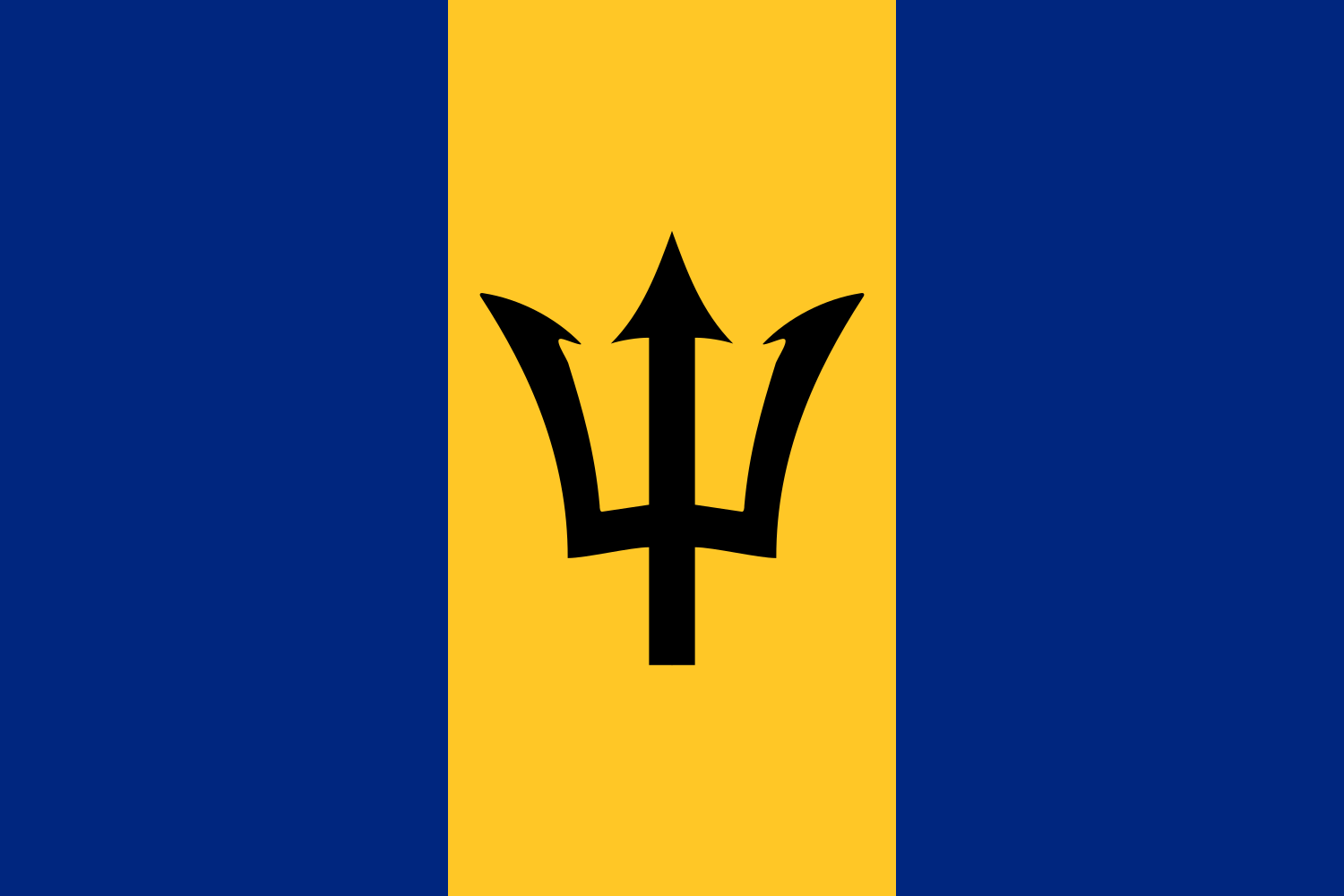
- description: three equal vertical bands of ultramarine blue (left side), gold, and ultramarine blue with a black trident head centered on the gold band
meaning: blue stands for the sea and sky, and gold for the beaches; the trident head represents independence and a break with the past - National symbol(s)
- Neptune's trident, pelican, red bird of paradise flower (also known as "Pride of Barbados")
- National color(s)
- blue, yellow, black
- National anthem(s)
- title: "The National Anthem of Barbados"lyrics/music: Irving BURGIE/C. Van Roland EDWARDShistory: adopted 1966
- National heritage
- total World Heritage Sites: 1 (cultural)selected World Heritage Site locales: Historic Bridgetown and its Garrison
Economy 29 fields
- Economic overview
- high-income Eastern Caribbean economy; high standard of living among regional peers; key tourism, construction, and financial sectors driving recent GDP growth; declining but still very high public debt leading to IMF support programs; susceptible to natural disasters and reliance on import partners
- Real GDP (purchasing power parity)
- Real GDP (purchasing power parity) 2024: $5.634 billion (2024 est.)Real GDP (purchasing power parity) 2023: $5.428 billion (2023 est.)Real GDP (purchasing power parity) 2022: $5.214 billion (2022 est.)
- Real GDP growth rate
- Real GDP growth rate 2024: 3.8% (2024 est.)Real GDP growth rate 2023: 4.1% (2023 est.)Real GDP growth rate 2022: 17.8% (2022 est.)
- Real GDP per capita
- Real GDP per capita 2024: $19,900 (2024 est.)Real GDP per capita 2023: $19,200 (2023 est.)Real GDP per capita 2022: $18,500 (2022 est.)
- GDP (official exchange rate)
- $7.165 billion (2024 est.)
note: data in current dollars at official exchange rate - Inflation rate (consumer prices)
- Inflation rate (consumer prices) 2024: -0.5% (2024 est.)Inflation rate (consumer prices) 2023: 9.8% (2023 est.)Inflation rate (consumer prices) 2019: 4.1% (2019 est.)
- GDP - composition, by sector of origin
- agriculture: 1.9% (2023 est.)industry: 13.2% (2023 est.)services: 75.4% (2023 est.)
- GDP - composition, by end use
- household consumption: 75.6% (2022 est.)government consumption: 11.8% (2022 est.)investment in fixed capital: 16.5% (2022 est.)investment in inventories: 0.2% (2022 est.)exports of goods and services: 34.3% (2022 est.)imports of goods and services: -42.2% (2022 est.)
- Agricultural products
- sugarcane, chicken, vegetables, milk, eggs, sweet potatoes, pork, coconuts, tropical fruits, pulses (2023)
note: top ten agricultural products based on tonnage - Industries
- tourism, sugar, light manufacturing, component assembly for export
- Industrial production growth rate
- -1.3% (2023 est.)
note: annual % change in industrial value added based on constant local currency - Labor force
- 147,200 (2024 est.)
note: number of people ages 15 or older who are employed or seeking work - Unemployment rate
- Unemployment rate 2024: 7.6% (2024 est.)Unemployment rate 2023: 7.9% (2023 est.)Unemployment rate 2022: 8.4% (2022 est.)
- Youth unemployment rate (ages 15-24)
- total: 23.7% (2024 est.)male: 27.5% (2024 est.)female: 19.6% (2024 est.)
- Gini Index coefficient - distribution of family income
- Gini Index coefficient - distribution of family income 2016: 34.1 (2016 est.)
- Household income or consumption by percentage share
- lowest 10%: 2.5% (2016 est.)highest 10%: 25.8% (2016 est.)
- Remittances
- Remittances 2023: 1.3% of GDP (2023 est.)Remittances 2022: 1.4% of GDP (2022 est.)Remittances 2021: 1.6% of GDP (2021 est.)
- Budget
- revenues: $1.269 billion (2015 est.)expenditures: $1.664 billion (2015 est.)
- Public debt
- Public debt 2016: 133.2% of GDP (2016 est.)
- Taxes and other revenues
- 24.9% (of GDP) (2016 est.)
note: central government tax revenue as a % of GDP - Current account balance
- Current account balance 2017: -$296.396 million (2017 est.)Current account balance 2016: -$452.39 million (2016 est.)Current account balance 2015: -$98.732 million (2015 est.)
- Exports
- Exports 2017: $2.228 billion (2017 est.)Exports 2016: $2.41 billion (2016 est.)Exports 2015: $2.358 billion (2015 est.)
- Exports - partners
- USA 22%, Jamaica 17%, Trinidad & Tobago 8%, Canada 6%, Guyana 6% (2023)
note: top five export partners based on percentage share of exports - Exports - commodities
- liquor, refined petroleum, packaged medicine, margarine, baked goods (2023)
note: top five export commodities based on value in dollars - Imports
- Imports 2021: $2.12 billion (2021 est.)Imports 2017: $2.213 billion (2017 est.)Imports 2016: $2.238 billion (2016 est.)
- Imports - partners
- USA 32%, Trinidad & Tobago 19%, Netherlands 6%, UK 6%, Guyana 5% (2023)
note: top five import partners based on percentage share of imports - Imports - commodities
- refined petroleum, crude petroleum, cars, plastic products, ships (2023)
note: top five import commodities based on value in dollars - Reserves of foreign exchange and gold
- Reserves of foreign exchange and gold 2023: $1.606 billion (2023 est.)Reserves of foreign exchange and gold 2022: $1.52 billion (2022 est.)Reserves of foreign exchange and gold 2021: $1.673 billion (2021 est.)
- Exchange rates
- Currency: Barbadian dollars (BBD) per US dollar -Exchange rates 2024: 2 (2024 est.)Exchange rates 2023: 2 (2023 est.)Exchange rates 2022: 2 (2022 est.)Exchange rates 2021: 2 (2021 est.)Exchange rates 2020: 2 (2020 est.)
Energy 7 fields
- Electricity access
- electrification - total population: 100% (2022 est.)
- Electricity
- installed generating capacity: 320,000 kW (2023 est.)consumption: 1.025 billion kWh (2023 est.)transmission/distribution losses: 64.586 million kWh (2023 est.)
- Electricity generation sources
- fossil fuels: 91.9% of total installed capacity (2023 est.)solar: 7.9% of total installed capacity (2023 est.)biomass and waste: 0.2% of total installed capacity (2023 est.)
- Coal
- exports: 4 metric tons (2023 est.)imports: 57 metric tons (2023 est.)
- Petroleum
- total petroleum production: 2,000 bbl/day (2023 est.)refined petroleum consumption: 8,000 bbl/day (2023 est.)crude oil estimated reserves: 1.978 million barrels (2021 est.)
- Natural gas
- production: 7.957 million cubic meters (2023 est.)consumption: 32.593 million cubic meters (2023 est.)imports: 24.636 million cubic meters (2023 est.)proven reserves: 113.267 million cubic meters (2021 est.)
- Energy consumption per capita
- Total energy consumption per capita 2023: 68.293 million Btu/person (2023 est.)
Communications 6 fields
- Telephones - fixed lines
- total subscriptions: 121,000 (2022 est.)subscriptions per 100 inhabitants: 43 (2022 est.)
- Telephones - mobile cellular
- total subscriptions: 323,482 (2022 est.)subscriptions per 100 inhabitants: 115 (2022 est.)
- Broadcast media
- government-owned Caribbean Broadcasting Corporation (CBC) operates the lone terrestrial TV station; CBC also has a multi-channel cable TV subscription service; roughly a dozen CBC-operated radio stations operate alongside privately owned radio stations (2019)
- Internet country code
- .bb
- Internet users
- percent of population: 80% (2023 est.)
- Broadband - fixed subscriptions
- total: 106,000 (2022 est.)subscriptions per 100 inhabitants: 37 (2022 est.)
Transportation 5 fields
- Civil aircraft registration country code prefix
- 8P
- Airports
- 1 (2025)
- Heliports
- 1 (2025)
- Merchant marine
- total: 272 (2023)by type: bulk carrier 90, general cargo 149, oil tanker 5, other 28
- Ports
- total ports: 1 (2024)large: 0medium: 0small: 1very small: 0ports with oil terminals: 1key ports: Bridgetown
Military and Security 6 fields
- Military and security forces
- Barbados Defense Force (BDF): The Barbados Regiment, The Barbados Coast Guard (2025)
note 1: the Barbados Police Service (TBPS) is the national police force; it is modeled after London's Metropolitan Police Service and divided into three territorial divisions
note 2: the Barbados Cadet Corps is a national youth organization affiliated with the BDF; membership is open to all school children in Barbados between the ages of 11 and 18 - Military expenditures
- Military Expenditures 2024: 0.7% of GDP (2024 est.)Military Expenditures 2023: 0.7% of GDP (2023 est.)Military Expenditures 2022: 0.8% of GDP (2022 est.)Military Expenditures 2021: 0.9% of GDP (2021 est.)Military Expenditures 2020: 0.9% of GDP (2020 est.)
- Military and security service personnel strengths
- approximately 600 active BDF personnel (2025)
- Military equipment inventories and acquisitions
- the BDF's major equipment inventory is comprised mostly of donated items from China, the Netherlands, and the US (2025)
- Military service age and obligation
- 18-25 for voluntary active service at the start of recruit training; 18-30 for reserves (2025)
- Military - note
- formed in 1979, the Barbados Defense Force (BDF) is responsible for protecting national security, but it may also be called up to maintain internal public order in times of crisis, emergency, or other specific needs, such as special joint patrols with the police; it also provides humanitarian assistance and disaster response operations both domestically and regionally; other duties include assisting with national development, such as through the training of the country's youth with the units of the Barbados Cadet Corps
Barbados has been a member of the Caribbean Regional Security System (RSS) since its creation in 1982; RSS signatories (Antigua and Barbuda, Dominica, Grenada, Guyana, Saint Kitts and Nevis, Saint Lucia, and Saint Vincent and the Grenadines) agreed to prepare contingency plans and assist one another, on request, in national emergencies, prevention of smuggling, search and rescue, immigration control, fishery protection, customs and excise control, maritime policing duties, protection of off-shore installations, pollution control, national and other disasters, and threats to national security; the RSS is headquartered in Barbados (2025)
Transnational Issues 2 fields
- Refugees and internally displaced persons
- refugees: 13 (2024 est.)
- Trafficking in persons
- tier rating: Tier 2 Watch List — Barbados did not demonstrate overall increasing efforts to eliminate trafficking compared with the previous reporting period and was downgraded to Tier 2 Watch List; for more details, go to: https://www.state.gov/reports/2025-trafficking-in-persons-report/barbados/
Frequently asked
- What is the population of Barbados in 2025?
- Barbados has a population of 282,623 (282,623) according to World Bank, World Development Indicators data for 2025.
- What is the capital of Barbados?
- The capital of Barbados is Bridgetown.
- How large is the economy of Barbados?
- Barbados's GDP is $8.02B (2025, World Bank, World Development Indicators), which is $28,365 per capita.
- Who leads Barbados?
- Head of state: Sandra Mason (since November 30, 2021). Head of government: Mia Mottley (since May 25, 2018). Source: Wikidata, checked August 11, 2026.
Barbados