Turks and Caicos Islands
Updated
Population
46,855
2025 · World Bank
GDP
$1.75B
2024 · World Bank
GDP per capita
$37,507
2024 · World Bank
Area
948 km²
mledoze/countries reference dataset
Capital
Cockburn Town
Median age
39.2 yrs
2025 · UN WPP
Location
- Capital
- Cockburn Town
- Region
- Central America and the Caribbean
- Subregion
- Caribbean
- Area
- 948 km²
- Languages
- English
Then and now
The CIA World Factbook stopped updating in January 2026. This is what has changed since its final edition.
| Indicator | Factbook, final edition | Current | Change |
|---|---|---|---|
| Population | 60,4392024 | 46,8552025 | -22.5% |
| GDP (nominal) | $1.75B2024 | $1.75B2024 | 0.0% |
Trends since 2000
World Bank, World Development Indicators (CC BY 4.0).
6 facts about Turks and Caicos Islands
- 01 Turks and Caicos Islands ranks 208 of 238 in population, with 46,855 people as of 2025.
- 02 Its economy produced $1.75B in 2024, or $37,507 per person.
- 03 Turks and Caicos Islands has no land borders.
- 04 Population has grown 150% since 2000, from 18,730 to 46,855.
- 05 Prices sit at about 99% of United States levels (World Bank PPP data, 2024).
- 06 0% of the population uses the internet (1990).
Reference
- Languages
- English
- Currency
- United States dollar (USD)
- Calling code
- +1649
- Internet TLD
- .tc
- Demonym
- Turks and Caicos Islander
- ISO codes
- TC · TCA · 796
The Factbook archive 105 fields · 11 categories
The complete World Factbook entry for Turks and Caicos Islands: 105 fields and 160 sub-entries across 11 categories, kept whole as historical reference. A United States Government work in the public domain, reflecting data as of the final January 2026 edition; the live figures above supersede the fast-moving numbers in it. Last CIA update: January 5, 2026.
Introduction 1 field
- Background
- The islands were part of the UK's Jamaican colony until 1962, when they assumed the status of a separate Crown colony upon Jamaica's independence. The governor of The Bahamas oversaw affairs from 1965 to 1973. With Bahamian independence, the islands received a separate governor in 1973. Although independence was agreed upon for 1982, the policy was reversed, and the islands remain a British overseas territory. Grand Turk Island suffered extensive damage from Hurricane Maria in 2017.
Geography 17 fields
- Location
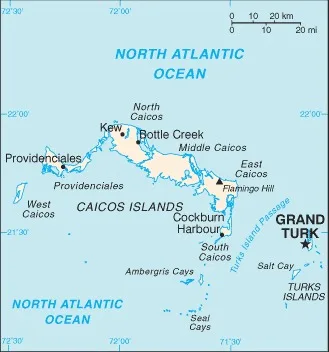
- two island groups in the North Atlantic Ocean, southeast of The Bahamas, north of Haiti; note - although the Turks and Caicos Islands do not border the Caribbean Sea, geopolitically they are often designated as being Caribbean
- Geographic coordinates
- 21 45 N, 71 35 W
- Map references
- Central America and the Caribbean
- Area
- total: 948 sq kmland: 948 sq kmwater: 0 sq km
- Area - comparative
- 2.5 times the size of Washington, D.C.
- Land boundaries
- total: 0 km
- Coastline
- 389 km
- Maritime claims
- territorial sea: 12 nmexclusive fishing zone: 200 nm
- Climate
- tropical; marine; moderated by trade winds; sunny and relatively dry
- Terrain
- low, flat limestone; extensive marshes and mangrove swamps
- Elevation
- highest point: Blue Hill on Providenciales and Flamingo Hill on East Caicos 48 mlowest point: Atlantic Ocean 0 m
- Natural resources
- spiny lobster, conch
- Land use
- agricultural land: 1.1% (2023 est.)agricultural land: arable land: arable land: 1.1% (2023 est.)agricultural land: permanent crops: permanent crops: 0% (2022 est.)agricultural land: permanent pasture: permanent pasture: 0% (2022 est.)forest: 11.1% (2023 est.)other: 87.9% (2023 est.)
- Irrigated land
- 0 sq km (2022)
- Population distribution
- eight of the thirty islands are inhabited; the island of Providenciales is the most populated, but the most densely populated is Grand Turk
- Natural hazards
- frequent hurricanes
- Geography - note
- include eight large islands and numerous smaller cays, islets, and reefs; only two of the Caicos Islands and six of the Turks group are inhabited
People and Society 28 fields
- Population
- total: 60,439 (2024 est.)male: 30,389female: 30,050
- Nationality
- noun: noneadjective: none
- Ethnic groups
- Black 87.6%, White 7.9%, mixed 2.5%, East Indian 1.3%, other 0.7% (2006 est.)
- Languages
- English (official)
- Religions
- Protestant 72.8% (Baptist 35.8%, Church of God 11.7%, Anglican 10%, Methodist 9.3%, Seventh Day Adventist 6%), Roman Catholic 11.4%, Jehovah's Witness 1.8%, other 14% (2006 est.)
- Age structure
- 0-14 years: 20.4% (male 6,288/female 6,056)15-64 years: 73.2% (male 22,232/female 22,011)65 years and over: 6.4% (2024 est.) (male 1,869/female 1,983)
- Dependency ratios
- total dependency ratio: 36.6 (2024 est.)youth dependency ratio: 27.9 (2024 est.)elderly dependency ratio: 8.7 (2024 est.)potential support ratio: 11.5 (2024 est.)
- Median age
- total: 36.6 years (2025 est.)male: 36.5 yearsfemale: 36.1 years
- Population growth rate
- 1.73% (2025 est.)
- Birth rate
- 12.73 births/1,000 population (2025 est.)
- Death rate
- 3.59 deaths/1,000 population (2025 est.)
- Net migration rate
- 8.13 migrant(s)/1,000 population (2025 est.)
- Population distribution
- eight of the thirty islands are inhabited; the island of Providenciales is the most populated, but the most densely populated is Grand Turk
- Urbanization
- urban population: 94.2% of total population (2023)rate of urbanization: 1.46% annual rate of change (2020-25 est.)
- Major urban areas - population
- 5,000 GRAND TURK (capital) (2018)
- Sex ratio
- at birth: 1.05 male(s)/female0-14 years: 1.04 male(s)/female15-64 years: 1.01 male(s)/female65 years and over: 0.94 male(s)/femaletotal population: 1.01 male(s)/female (2024 est.)
- Infant mortality rate
- total: 10.8 deaths/1,000 live births (2025 est.)male: 13.9 deaths/1,000 live birthsfemale: 8.1 deaths/1,000 live births
- Life expectancy at birth
- total population: 81.3 years (2024 est.)male: 78.5 yearsfemale: 84.1 years
- Total fertility rate
- 1.7 children born/woman (2025 est.)
- Gross reproduction rate
- 0.83 (2025 est.)
- Drinking water source
- improved: urban: urban: 99.2% of population (2022 est.)improved: rural: rural: 91.8% of population (2022 est.)improved: total: total: 98.8% of population (2022 est.)unimproved: urban: urban: 0.8% of population (2022 est.)unimproved: rural: rural: 8.2% of population (2022 est.)unimproved: total: total: 1.2% of population (2022 est.)
- Sanitation facility access
- improved: urban: urban: 98.8% of population (2022 est.)improved: rural: rural: 97.7% of population (2022 est.)improved: total: total: 98.7% of population (2022 est.)unimproved: urban: urban: 1.2% of population (2022 est.)unimproved: rural: rural: 2.3% of population (2022 est.)unimproved: total: total: 1.3% of population (2022 est.)
- Children under the age of 5 years underweight
- 0.4% (2020 est.)
- Currently married women (ages 15-49)
- 59.3% (2020 est.)
- Child marriage
- women married by age 15: 0% (2020)women married by age 18: 23.3% (2020)men married by age 18: 5.1% (2020)
- Education expenditure
- Education expenditure (% GDP): 2.9% of GDP (2024 est.)Education expenditure (% national budget): 9.8% national budget (2025 est.)
- School life expectancy (primary to tertiary education)
- total: 14 years (2023 est.)male: 15 years (2023 est.)female: 14 years (2023 est.)
- People - note
- destination and transit point for illegal Haitian immigrants bound for the Bahamas and the US
Environment 5 fields
- Environmental issues
- limited natural freshwater resources
- Climate
- tropical; marine; moderated by trade winds; sunny and relatively dry
- Land use
- agricultural land: 1.1% (2023 est.)agricultural land: arable land: arable land: 1.1% (2023 est.)agricultural land: permanent crops: permanent crops: 0% (2022 est.)agricultural land: permanent pasture: permanent pasture: 0% (2022 est.)forest: 11.1% (2023 est.)other: 87.9% (2023 est.)
- Urbanization
- urban population: 94.2% of total population (2023)rate of urbanization: 1.46% annual rate of change (2020-25 est.)
- Carbon dioxide emissions
- total emissions: 447,000 metric tonnes of CO2 (2023 est.)from petroleum and other liquids: 447,000 metric tonnes of CO2 (2023 est.)
Government 19 fields
- Country name
- conventional long form: noneconventional short form: Turks and Caicos Islandsabbreviation: TCAetymology: the Turks Islands are named after the Turk's cap cactus, which is native to the islands and appears on the flag and coat of arms; the name Caicos may derive from caya hico, a phrase meaning “string of islands” in the Lucayan (Arawak) language, or from the Spanish word cayo, meaning "rock"
- Government type
- parliamentary democracy
- Dependency status
- overseas territory of the UK
- Capital
- name: Grand Turk (Cockburn Town)geographic coordinates: 21 28 N, 71 08 Wtime difference: UTC-5 (same time as Washington, DC, during Standard Time)daylight saving time: +1hr, begins second Sunday in March; ends first Sunday in Novemberetymology: named after Sir Francis COCKBURN, who served as governor of the Bahamas from 1837 to 1844
- Legal system
- mixed system of English common law and civil law
- Constitution
- history: several previous; latest signed 7 August 2012, effective 15 October 2012 (The Turks and Caicos Constitution Order 2011)
- Citizenship
- see United Kingdom
- Suffrage
- 18 years of age; universal
- Executive branch
- chief of state: King CHARLES III (since 8 September 2022); represented by Governor Dileeni Daniel-SELVARATNAM (since 29 June 2023)head of government: Premier Washington MISICK (since 19 February 2021)cabinet: Cabinet appointed by the governor from among members of the House of Assemblyelection/appointment process: the monarch is hereditary; governor appointed by the monarch; following legislative elections, the governor appoints the leader of the majority party as the premier
- Legislative branch
- legislature name: House of Assemblylegislative structure: unicameralnumber of seats: 21 (directly elected or appointed)electoral system: mixedscope of elections: full renewalterm in office: 4 yearsmost recent election date: 2/07/2025parties elected and seats per party: PNP (16); PDM (2); independents (1)percentage of women in chamber: 27.3%expected date of next election: 2029
- Judicial branch
- highest court(s): Supreme Court (consists of the chief justice and other judges, as determined by the governor); Court of Appeal (consists of the court president and 2 justices)judge selection and term of office: Supreme Court and Appeals Court judges appointed by the governor in accordance with the Judicial Service Commission, a 3-member body of high-level judicial officials; Supreme Court judges serve until mandatory retirement at age 65, but terms can be extended to age 70; Appeals Court judge tenure determined by individual terms of appointmentsubordinate courts: magistrates' courts
- Political parties
- People's Democratic Movement or PDM
Progressive National Party or PNP - Diplomatic representation in the US
- none (overseas territory of the UK)
- Diplomatic representation from the US
- embassy: none (overseas territory of the UK)
- International organization participation
- Caricom (associate), CDB, Interpol (subbureau), UPU
- Independence
- none (overseas territory of the UK)
- Flag
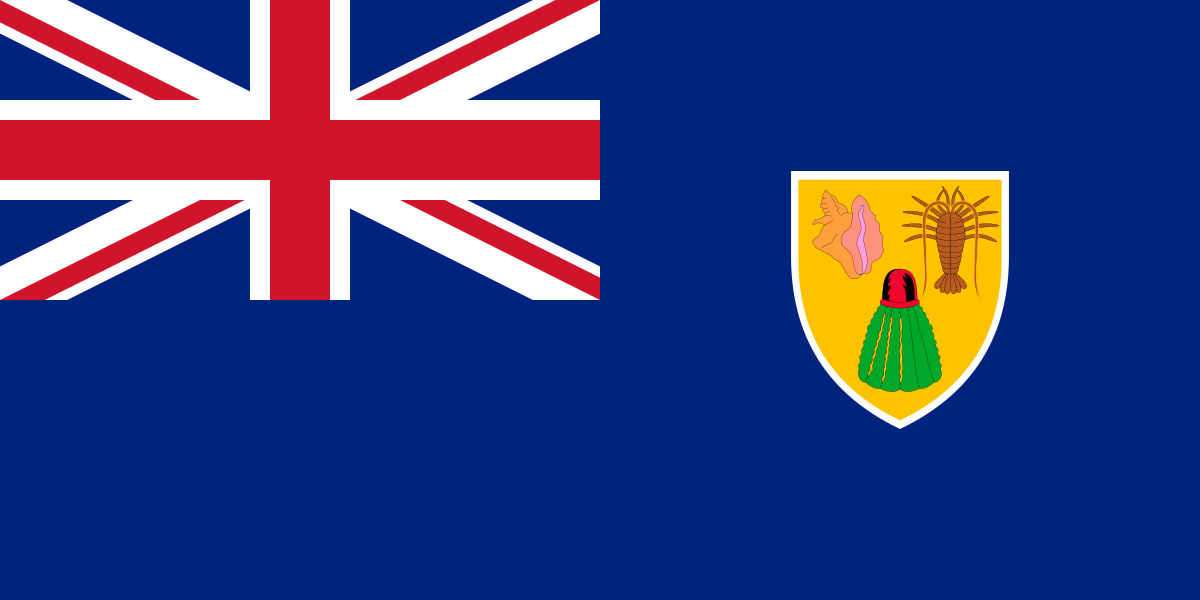
- description: blue with the UK flag in the upper-left quadrant and the colonial shield centered on the right half of the flag; the shield is yellow and displays a conch shell, a spiny lobster, and Turk's cap cactus
- National symbol(s)
- conch shell, Turk's cap cactus
- National anthem(s)
- title: "This Land of Ours"lyrics/music: Conrad HOWELLhistory: serves as a local anthem
_____title: "God Save the King"lyrics/music: unknownhistory: official anthem, as a UK overseas territory
Economy 20 fields
- Economic overview
- British Caribbean island territorial economy; GDP and its tourism industry hit hard by COVID-19 disruptions; major biodiversity locale; US dollar user; fossil fuel dependent; negative trade balance; increasing unemployment
- Real GDP (purchasing power parity)
- Real GDP (purchasing power parity) 2024: $1.554 billion (2024 est.)Real GDP (purchasing power parity) 2023: $1.471 billion (2023 est.)Real GDP (purchasing power parity) 2022: $1.293 billion (2022 est.)
- Real GDP growth rate
- Real GDP growth rate 2024: 5.6% (2024 est.)Real GDP growth rate 2023: 13.7% (2023 est.)Real GDP growth rate 2022: 14.1% (2022 est.)
- Real GDP per capita
- Real GDP per capita 2024: $33,400 (2024 est.)Real GDP per capita 2023: $31,800 (2023 est.)Real GDP per capita 2022: $28,200 (2022 est.)
- GDP (official exchange rate)
- $1.745 billion (2024 est.)
note: data in current dollars at official exchange rate - Inflation rate (consumer prices)
- Inflation rate (consumer prices) 2022: 8.5% (2022 est.)Inflation rate (consumer prices) 2021: 5% (2021 est.)Inflation rate (consumer prices) 2020: 2.3% (2020 est.)
- GDP - composition, by sector of origin
- agriculture: 0.4% (2024 est.)industry: 9.3% (2024 est.)services: 72.6% (2024 est.)
- Agricultural products
- corn, beans, cassava (manioc, tapioca), citrus fruits; fish
- Industries
- tourism, offshore financial services
- Industrial production growth rate
- 9% (2024 est.)
note: annual % change in industrial value added based on constant local currency - Remittances
- Remittances 2023: 0% of GDP (2023 est.)Remittances 2022: 0% of GDP (2022 est.)Remittances 2021: 0% of GDP (2021 est.)
- Budget
- revenues: $247.3 million (2017 est.)expenditures: $224.3 million (2017 est.)
- Current account balance
- Current account balance 2018: $172.709 million (2018 est.)Current account balance 2017: $35.016 million (2017 est.)Current account balance 2016: $247.081 million (2016 est.)
- Exports
- Exports 2018: $826.824 million (2018 est.)Exports 2017: $602.581 million (2017 est.)Exports 2016: $741.173 million (2016 est.)
- Exports - partners
- Gabon 27%, USA 25%, Zimbabwe 17%, Czechia 8%, UAE 3% (2023)
note: top five export partners based on percentage share of exports - Exports - commodities
- plastics, shellfish, carbonates, tobacco, garments (2023)
note: top five export commodities based on value in dollars - Imports
- Imports 2018: $544.219 million (2018 est.)Imports 2017: $484.842 million (2017 est.)Imports 2016: $438.041 million (2016 est.)
- Imports - partners
- USA 73%, Dominican Republic 4%, Italy 3%, Japan 3%, China 2% (2023)
note: top five import partners based on percentage share of imports - Imports - commodities
- refined petroleum, cars, aluminum structures, furniture, plastic products (2023)
note: top five import commodities based on value in dollars - Exchange rates
- the US dollar is used
Energy 4 fields
- Electricity access
- electrification - total population: 99.9% (2022 est.)electrification - urban areas: 100%electrification - rural areas: 100%
- Electricity
- installed generating capacity: 94,000 kW (2023 est.)consumption: 252.088 million kWh (2023 est.)transmission/distribution losses: 12.912 million kWh (2023 est.)
- Electricity generation sources
- fossil fuels: 98.1% of total installed capacity (2023 est.)solar: 1.9% of total installed capacity (2023 est.)
- Petroleum
- refined petroleum consumption: 3,000 bbl/day (2023 est.)
Communications 5 fields
- Telephones - fixed lines
- total subscriptions: 4,000 (2021 est.)subscriptions per 100 inhabitants: 9 (2022 est.)
- Telephones - mobile cellular
- total subscriptions: 25,085 (2004 est.)subscriptions per 100 inhabitants: 110 (2004 est.)
- Broadcast media
- no local terrestrial TV stations; broadcasts from the Bahamas, multi-channel cable, and satellite TV available; state-run radio network operates alongside private broadcasters, with a total of about 15 stations
- Internet country code
- .tc
- Internet users
- percent of population: 93.5% (2022)
Transportation 4 fields
- Civil aircraft registration country code prefix
- VQ-T
- Airports
- 9 (2025)
- Merchant marine
- total: 3 (2023)by type: general cargo 1, other 2
- Ports
- total ports: 3 (2024)large: 0medium: 0small: 0very small: 2size unknown: 1ports with oil terminals: 1key ports: Cockburn Harbor, Grand Turk, Providenciales
Military and Security 1 field
- Military - note
- defense is the responsibility of the UK
Transnational Issues 1 field
- Refugees and internally displaced persons
- refugees: 8 (2024 est.)
Frequently asked
- What is the population of Turks and Caicos Islands in 2025?
- Turks and Caicos Islands has a population of 46,855 (46,855) according to World Bank, World Development Indicators data for 2025.
- What is the capital of Turks and Caicos Islands?
- The capital of Turks and Caicos Islands is Cockburn Town.
- How large is the economy of Turks and Caicos Islands?
- Turks and Caicos Islands's GDP is $1.75B (2024, World Bank, World Development Indicators), which is $37,507 per capita.
Turks and Caicos Islands