Mauritania
Islamic Republic of Mauritania
Updated
Population
5.32 million
2025 · World Bank
GDP
$11.68B
2025 · World Bank
GDP per capita
$2,198
2025 · World Bank
Area
1,030,700 km²
mledoze/countries reference dataset
Capital
Nouakchott
Median age
17.4 yrs
2025 · UN WPP
Location
- Capital
- Nouakchott
- Region
- Africa
- Subregion
- Western Africa
- Area
- 1,030,700 km²
- Neighbours
- 4
- Languages
- Arabic
Leadership
- Head of state
- Mohamed Ould Ghazouani
- In office since August 1, 2019
- Head of government
- Moctar Ould Djay
- In office since August 2, 2024
Wikidata (CC0), checked August 11, 2026. Frozen Factbook mirrors still list the officeholders of January 2026.
Then and now
The CIA World Factbook stopped updating in January 2026. This is what has changed since its final edition.
| Indicator | Factbook, final edition | Current | Change |
|---|---|---|---|
| Population | 5,202,1092025 | 5,315,0652025 | +2.2% |
| GDP (nominal) | $10.77B2024 | $11.68B2025 | +8.5% |
| Inflation rate | 2.5%2024 | 1.5%2025 | -1.0 pp |
Trends since 2000
World Bank, World Development Indicators (CC BY 4.0).
6 facts about Mauritania
- 01 Mauritania ranks 125 of 238 in population, with 5.32 million people as of 2025.
- 02 Its economy produced $11.68B in 2025, or $2,198 per person.
- 03 It shares land borders with 4 neighbours: Algeria, Mali, Senegal, Western Sahara.
- 04 Population has grown 103% since 2000, from 2.61 million to 5.32 million.
- 05 Prices sit at about 31% of United States levels (World Bank PPP data, 2023).
- 06 46% of the population uses the internet (2024).
Reference
- Languages
- Arabic
- Currency
- Mauritanian ouguiya (MRU)
- Calling code
- +222
- Internet TLD
- .mr
- Demonym
- Mauritanian
- ISO codes
- MR · MRT · 478
Land borders
Compare Mauritania
The Factbook archive 147 fields · 12 categories
The complete World Factbook entry for Mauritania: 147 fields and 245 sub-entries across 12 categories, kept whole as historical reference. A United States Government work in the public domain, reflecting data as of the final January 2026 edition; the live figures above supersede the fast-moving numbers in it. Last CIA update: January 18, 2026.
Introduction 1 field
- Background
- The Amazigh and Bafour people were among the earliest settlers in what is now Mauritania and among the first in recorded history to convert from a nomadic to agricultural lifestyle. These groups account for roughly one third of Mauritania’s ethnic makeup. The remainder of Mauritania’s ethnic groups derive from Sub-Saharan ethnic groups originating mainly from the Senegal River Valley, including descendants of former enslaved peoples. These three groups are organized according to a strict caste system with deep ethnic divides that impact access to resources and power dynamics.
A former French colony, Mauritania achieved independence from France in 1960. Mauritania initially began as a single-party, authoritarian regime and experienced 49 years of dictatorships, flawed elections, failed attempts at democracy, and military coups. Ould Abdel AZIZ led the last coup in 2008, was elected president in 2009, and was reelected in 2014. Mohamed Ould Cheikh GHAZOUANI was elected president in 2019, and his inauguration marked the first peaceful transition of power from one democratically elected president to another, solidifying the country's status as an emerging democracy. International observers recognized the elections as relatively free and fair. GHAZOUANI is seeking re-election in June 2024 for a second, and final, five-year term. The country is working to address vestigial practices of slavery and its hereditary impacts. Mauritania officially abolished slavery in 1981, but the practice was not criminalized until 2007. Between 2005 and 2011, Al-Qaeda in the Islamic Maghreb (AQIM) launched a series of attacks killing western tourists and aid workers, attacking diplomatic and government facilities, and ambushing Mauritanian soldiers and gendarmes. Although Mauritania has not seen an attack since 2011, AQIM and similar groups remain active in the Sahel region.
Geography 20 fields
- Location
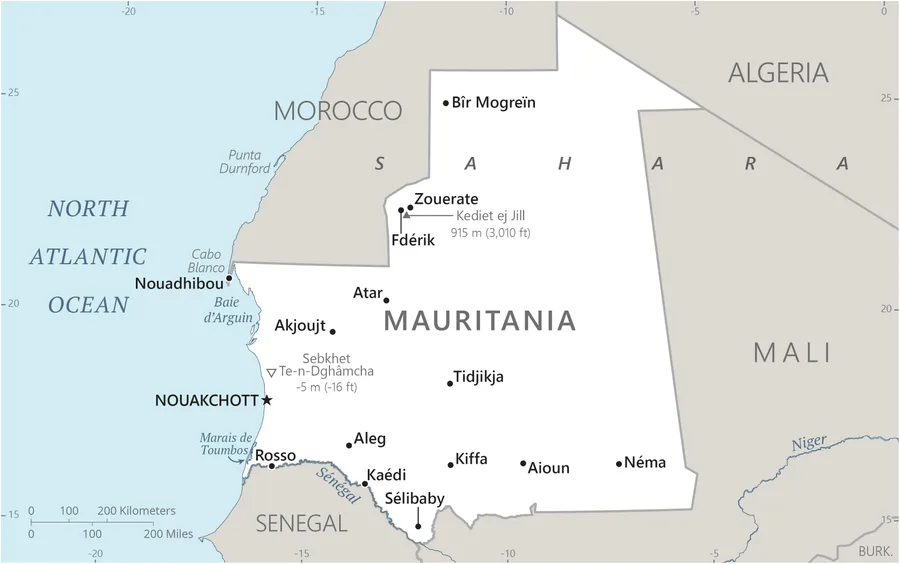
- Western Africa, bordering the North Atlantic Ocean, between Senegal and Western Sahara
- Geographic coordinates
- 20 00 N, 12 00 W
- Map references
- Africa
- Area
- total: 1,030,700 sq kmland: 1,030,700 sq kmwater: 0 sq km
- Area - comparative
- slightly larger than three times the size of New Mexico; about six times the size of Florida
- Land boundaries
- total: 5,002 kmborder countries: Algeria 460 km; Mali 2,236 km; Morocco 1,564 km; Senegal 742 km
- Coastline
- 754 km
- Maritime claims
- territorial sea: 12 nmcontiguous zone: 24 nmexclusive economic zone: 200 nmcontinental shelf: 200 nm or to the edge of the continental margin
- Climate
- desert; constantly hot, dry, dusty
- Terrain
- mostly barren, flat plains of the Sahara; some central hills
- Elevation
- highest point: Kediet Ijill 915 mlowest point: Sebkhet Te-n-Dghamcha -5 mmean elevation: 276 m
- Natural resources
- iron ore, gypsum, copper, phosphate, diamonds, gold, oil, fish
- Land use
- agricultural land: 38.5% (2023 est.)agricultural land: arable land: arable land: 0.4% (2023 est.)agricultural land: permanent crops: permanent crops: 0% (2023 est.)agricultural land: permanent pasture: permanent pasture: 38.1% (2023 est.)forest: 1% (2023 est.)other: 60.5% (2023 est.)
- Irrigated land
- 450 sq km (2012)
- Major rivers (by length in km)
- Senegal river mouth (shared with Guinea [s], Senegal and Mali) - 1,641 km
note: [s] after country name indicates river source; [m] after country name indicates river mouth - Major watersheds (area sq km)
- Atlantic Ocean drainage: Niger (2,261,741 sq km), Senegal (456,397 sq km)
- Major aquifers
- Senegalo-Mauritanian Basin, Taodeni-Tanzerouft Basin
- Population distribution
- vast areas of the country, particularly in the central, northern, and eastern areas, are desert and lack sizeable population clusters; half the population lives in or around the coastal capital of Nouakchott; smaller clusters are found near the southern border with Mali and Senegal, as shown in this population distribution map
- Natural hazards
- hot, dry, dust/sand-laden sirocco wind primarily in March and April; periodic droughts
- Geography - note
- Mauritania is considered part of both North Africa's Maghreb region and West Africa's Sahel region; most of the population is concentrated in the cities of Nouakchott and Nouadhibou and along the Senegal River in the southern part of the country
People and Society 35 fields
- Population
- total: 5,202,109 (2025 est.)male: 2,578,114female: 2,623,995
- Nationality
- noun: Mauritanian(s)adjective: Mauritanian
- Ethnic groups
- Black Moors (Haratines - Arabic-speaking descendants of African origin who are or were enslaved by White Moors) 40%, White Moors (of Arab-Amazigh descent, known as Beydane) 30%, Sub-Saharan Mauritanians (non-Arabic speaking, largely resident in or originating from the Senegal River Valley, including Halpulaar, Fulani, Soninke, Wolof, and Bambara ethnic groups) 30%
- Languages
- Languages: Arabic (official and national), Pular, Soninke, Wolof (all national languages), Frenchmajor-language sample(s):
كتاب حقائق العالم، المصدر الذي لا يمكن الاستغناء عنه للمعلومات الأساسية (Arabic)
The World Factbook, the indispensable source for basic information. - Religions
- Muslim (official) 100%
- Age structure
- 0-14 years: 35.7% (male 776,035/female 770,132)15-64 years: 59.9% (male 1,227,347/female 1,363,938)65 years and over: 4.4% (2024 est.) (male 80,308/female 110,280)
- Dependency ratios
- total dependency ratio: 84.7 (2025 est.)youth dependency ratio: 77.8 (2025 est.)elderly dependency ratio: 7 (2025 est.)potential support ratio: 14.3 (2025 est.)
- Median age
- total: 18.6 years (2025 est.)male: 21.1 yearsfemale: 23.1 years
- Population growth rate
- 2.88% (2025 est.)
- Birth rate
- 34.01 births/1,000 population (2025 est.)
- Death rate
- 5.18 deaths/1,000 population (2025 est.)
- Net migration rate
- 0 migrant(s)/1,000 population (2025 est.)
- Population distribution
- vast areas of the country, particularly in the central, northern, and eastern areas, are desert and lack sizeable population clusters; half the population lives in or around the coastal capital of Nouakchott; smaller clusters are found near the southern border with Mali and Senegal, as shown in this population distribution map
- Urbanization
- urban population: 57.7% of total population (2023)rate of urbanization: 3.84% annual rate of change (2020-25 est.)
- Major urban areas - population
- 1.492 million NOUAKCHOTT (capital) (2023)
- Sex ratio
- at birth: 1.03 male(s)/female0-14 years: 1.01 male(s)/female15-64 years: 0.9 male(s)/female65 years and over: 0.73 male(s)/femaletotal population: 0.93 male(s)/female (2024 est.)
- Mother's mean age at first birth
- 21.8 years (2019/21)
note: data represents median age at first birth among women 25-49 - Maternal mortality ratio
- 381 deaths/100,000 live births (2023 est.)
- Infant mortality rate
- total: 29.9 deaths/1,000 live births (2025 est.)male: 54.8 deaths/1,000 live birthsfemale: 42.9 deaths/1,000 live births
- Life expectancy at birth
- total population: 65.9 years (2024 est.)male: 63.4 yearsfemale: 68.5 years
- Total fertility rate
- 4.76 children born/woman (2025 est.)
- Gross reproduction rate
- 2.34 (2025 est.)
- Drinking water source
- improved: urban: urban: 94.6% of population (2022 est.)improved: rural: rural: 55.6% of population (2022 est.)improved: total: total: 77.8% of population (2022 est.)unimproved: urban: urban: 5.4% of population (2022 est.)unimproved: rural: rural: 44.4% of population (2022 est.)unimproved: total: total: 22.2% of population (2022 est.)
- Health expenditure
- Health expenditure (as % of GDP): 4.1% of GDP (2021)Health expenditure (as % of national budget): 6.3% of national budget (2022 est.)
- Physician density
- 0.26 physicians/1,000 population (2022)
- Sanitation facility access
- improved: urban: urban: 89.4% of population (2022 est.)improved: rural: rural: 33.9% of population (2022 est.)improved: total: total: 65.5% of population (2022 est.)unimproved: urban: urban: 10.6% of population (2022 est.)unimproved: rural: rural: 66.1% of population (2022 est.)unimproved: total: total: 34.5% of population (2022 est.)
- Obesity - adult prevalence rate
- 12.7% (2016)
- Alcohol consumption per capita
- total: 0 liters of pure alcohol (2019 est.)beer: 0 liters of pure alcohol (2019 est.)wine: 0 liters of pure alcohol (2019 est.)spirits: 0 liters of pure alcohol (2019 est.)other alcohols: 0 liters of pure alcohol (2019 est.)
- Tobacco use
- total: 8.3% (2025 est.)male: 15.5% (2025 est.)female: 1.7% (2025 est.)
- Children under the age of 5 years underweight
- 22.4% (2022 est.)
- Currently married women (ages 15-49)
- 66.1% (2020 est.)
- Child marriage
- women married by age 15: 15.5% (2021)women married by age 18: 36.6% (2021)men married by age 18: 1.2% (2021)
- Education expenditure
- Education expenditure (% GDP): 4.7% of GDP (2023 est.)Education expenditure (% national budget): 32% national budget (2024 est.)
- Literacy
- total population: 59.5% (2020 est.)male: 70.1% (2020 est.)female: 51.8% (2020 est.)
- School life expectancy (primary to tertiary education)
- total: 8 years (2020 est.)male: 8 years (2020 est.)female: 8 years (2020 est.)
Environment 10 fields
- Environmental issues
- desertification caused in part by overgrazing, deforestation, and drought-aggravated soil erosion; limited natural freshwater resources; locust infestation
- International environmental agreements
- party to: Biodiversity, Climate Change, Climate Change-Kyoto Protocol, Climate Change-Paris Agreement, Comprehensive Nuclear Test Ban, Desertification, Endangered Species, Hazardous Wastes, Law of the Sea, Nuclear Test Ban, Ozone Layer Protection, Ship Pollution, Wetlands, Whalingsigned, but not ratified: none of the selected agreements
- Climate
- desert; constantly hot, dry, dusty
- Land use
- agricultural land: 38.5% (2023 est.)agricultural land: arable land: arable land: 0.4% (2023 est.)agricultural land: permanent crops: permanent crops: 0% (2023 est.)agricultural land: permanent pasture: permanent pasture: 38.1% (2023 est.)forest: 1% (2023 est.)other: 60.5% (2023 est.)
- Urbanization
- urban population: 57.7% of total population (2023)rate of urbanization: 3.84% annual rate of change (2020-25 est.)
- Carbon dioxide emissions
- total emissions: 4.86 million metric tonnes of CO2 (2023 est.)from petroleum and other liquids: 4.86 million metric tonnes of CO2 (2023 est.)
- Particulate matter emissions
- 35.1 micrograms per cubic meter (2019 est.)
- Waste and recycling
- municipal solid waste generated annually: 454,000 tons (2024 est.)percent of municipal solid waste recycled: 10% (2022 est.)
- Total water withdrawal
- municipal: 95.4 million cubic meters (2022 est.)industrial: 31.8 million cubic meters (2022 est.)agricultural: 1.223 billion cubic meters (2022 est.)
- Total renewable water resources
- 11.4 billion cubic meters (2022 est.)
Government 23 fields
- Country name
- conventional long form: Islamic Republic of Mauritaniaconventional short form: Mauritanialocal long form: Al Jumhuriyah al Islamiyah al Muritaniyahlocal short form: Muritaniyahetymology: named for the ancient kingdom of Mauretania (3rd century B.C. to 1st century A.D.); its name derives from the Mauri (Moors) of northwest Africa
- Government type
- presidential republic
- Capital
- name: Nouakchottgeographic coordinates: 18 04 N, 15 58 Wtime difference: UTC 0 (5 hours ahead of Washington, DC, during Standard Time)etymology: the meaning of the name is unclear; it may derive from the Berber nawakshut, meaning "place of the winds;" other variants could translate as "the place where water appears in a new well," "the land where shells abound," "a place with pasture," "a windy place," or "without ears" (the last referring to a local chieftain who could have been the place's namesake)
- Administrative divisions
- 15 regions (wilayas, singular - wilaya); Adrar, Assaba, Brakna, Dakhlet Nouadhibou, Gorgol, Guidimaka, Hodh ech Chargui, Hodh El Gharbi, Inchiri, Nouakchott Nord, Nouakchott Ouest, Nouakchott Sud, Tagant, Tiris Zemmour, Trarza
- Legal system
- mixed system of Islamic and French civil law
- Constitution
- history: previous 1964; latest adopted 12 July 1991amendment process: proposed by the president of the republic or by Parliament; consideration of amendments by Parliament requires approval of at least one third of the membership; a referendum is held only if the amendment is approved by two-thirds majority vote; passage by referendum requires simple majority vote by eligible voters; passage of amendments proposed by the president can bypass a referendum if approved by at least three-fifths majority vote by Parliament
- International law organization participation
- has not submitted an ICJ jurisdiction declaration; non-party state to the ICCt
- Citizenship
- citizenship by birth: nocitizenship by descent only: at least one parent must be a citizen of Mauritaniadual citizenship recognized: noresidency requirement for naturalization: 5 years
- Suffrage
- 18 years of age; universal
- Executive branch
- chief of state: President Mohamed Ould Cheikh el GHAZOUANI (since 1 August 2019)head of government: Prime Minister Moctar Ould DIAY (since 2 August 2024)cabinet: Council of Ministers nominees suggested by the prime minister, appointed by the presidentelection/appointment process: president directly elected by absolute-majority popular vote in 2 rounds, if needed, for a 5-year term (eligible for a second term); prime minister appointed by the presidentmost recent election date: 29 June 2024election results:
2024: Mohamed Ould Cheikh el GHAZOUANI reelected president in first round; percent of vote - Mohamed Ould Cheikh el GHAZOUANI (UPR) 56.1%, Biram Dah Ould ABEID (independent) 22.1%, Hamadi Sidi el MOKHTAR independent) 12.8%, other 9.0%expected date of next election: June 2029 - Legislative branch
- legislature name: Parliament (Barlamane)legislative structure: unicameralchamber name: National Assembly (Al Jamiya-Al-Wataniya)number of seats: 176 (all directly elected)electoral system: mixed systemscope of elections: full renewalterm in office: 5 yearsmost recent election date: 5/13/2023 to 5/27/2023parties elected and seats per party: El Insaf (107); Tawassoul (11); Other (58)percentage of women in chamber: 23.3%expected date of next election: May 2028
- Judicial branch
- highest court(s): Supreme Court or Cour Suprême (subdivided into 7 chambers: 2 civil, 2 labor, 1 commercial, 1 administrative, and 1 criminal, each with a chamber president and 2 councilors); Constitutional Council (consists of 9 members); High Court of Justice (consists of 9 members)judge selection and term of office: Supreme Court president appointed by the president of the republic to serve a 5-year renewable term; Constitutional Council members appointed - 3 by the president of the republic, 2 by the president of the National Assembly, 1 by the prime minister, 1 by the leader of the democratic opposition, 1 by the largest opposition party in the National Assembly, and 1 by the second largest party in the National Assembly; members serve single, 9-year terms with one-third of membership renewed every 3 years; High Court of Justice members appointed by Parliament - 6 by the ruling Coalition of Majority Parties and 3 by opposition partiessubordinate courts: Courts of Appeal; courts of first instance, or wilya courts, are established in the regions' headquarters and include commercial and labor courts, criminal courts, Moughataa (district) Courts, and informal/customary courts
- Political parties
- Alliance for Justice and Democracy/Movement for Renewal or AJD/MR
El Insaf or Equity Party
El Islah or Reform Party
El Karama or Dignity Party
El Vadila or Virtue Party
Mauritanian Party of Union and Change or HATEM
National Democratic Alliance or AND
National Rally for Reform and Development or RNRD or TAWASSOUL
Nida El-Watan
Party for Conciliation and Prosperity or HIWAR
Party of the Mauritanian Masses or Hakam
Republican Front for Unity and Democracy or FRUD
Sawab Party
Union for Democracy and Progress or UDP
Union of Planning and Construction or UPC - Diplomatic representation in the US
- chief of mission: Ambassador Cissé Mint Cheikh Ould BOIDE (since 15 September 2021)chancery: 2129 Leroy Place NW, Washington, DC 20008telephone: [1] (202) 232-5700FAX: [1] (202) 319-2623email address and website:
[email protected]
mauritaniaembassyus.org – Mauritania Embassy washington - Diplomatic representation from the US
- chief of mission: Ambassador (vacant); Chargé d’Affaires Corina R. SANDERS (since September 2025)embassy: Nouadhibou Road, Avenue Al Quds, NOT PRTZ, Nouakchottmailing address: 2430 Nouakchott Place, Washington DC 20521-2430telephone: [222] 4525-2660FAX: [222] 4525-1592email address and website:
[email protected]
https://mr.usembassy.gov/ - International organization participation
- ABEDA, ACP, AfDB, AFESD, AIIB, AMF, AMU, AU, CAEU, EITI (compliant country), FAO, G-77, IAEA, IBRD, ICAO, ICC (NGOs), ICRM, IDA, IDB, IFAD, IFC, IFRCS, IHO (pending member), ILO, IMF, IMO, Interpol, IOC, IOM, IPU, ISO (correspondent), ITSO, ITU, ITUC (NGOs), LAS, MIGA, NAM, OIC, OIF, OPCW, UN, UNCTAD, UNESCO, UNHRC, UNIDO, UNWTO, UPU, WCO, WHO, WIPO, WMO, WTO
- Independence
- 28 November 1960 (from France)
- National holiday
- Independence Day, 28 November (1960)
- Flag
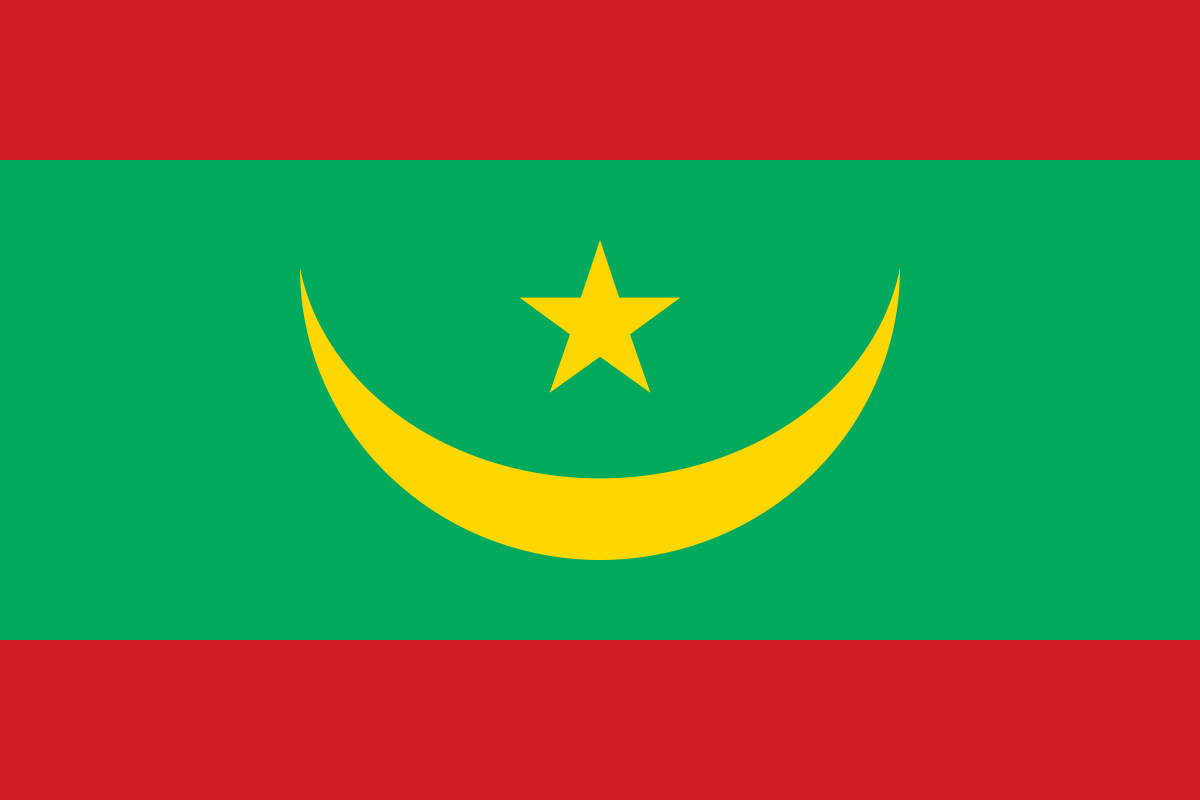
- description: green with red stripes along the top and bottom edges; on the green field, a five-pointed yellow star is centered over a yellow, upward-pointing crescent moon
meaning: the crescent, star, and color green are traditional symbols of Islam; green also represents hope for a bright future; yellow stands for the sands of the Sahara, and red for blood shed in the fight for independence - National symbol(s)
- five-pointed star between the horns of a horizontal crescent moon
- National color(s)
- green, yellow
- National anthem(s)
- title: "National Anthem of Mauritania"lyrics/music: unknown/Rageh DAOUDhistory: adopted 2017
- National heritage
- total World Heritage Sites: 2 (1 cultural, 1 natural)selected World Heritage Site locales: Ancient Ksour (Fortified Villages) of Ouadane, Chinguetti, Tichitt, and Oualata (c); Banc d'Arguin National Park (n)
Economy 30 fields
- Economic overview
- lower middle-income West African economy; primarily agrarian; rising urbanization; poor property rights; systemic corruption; endemic social and workforce tensions; wide-scale terrorism; foreign over-fishing; environmentally fragile
- Real GDP (purchasing power parity)
- Real GDP (purchasing power parity) 2024: $33.069 billion (2024 est.)Real GDP (purchasing power parity) 2023: $31.434 billion (2023 est.)Real GDP (purchasing power parity) 2022: $29.514 billion (2022 est.)
- Real GDP growth rate
- Real GDP growth rate 2024: 5.2% (2024 est.)Real GDP growth rate 2023: 6.5% (2023 est.)Real GDP growth rate 2022: 6.8% (2022 est.)
- Real GDP per capita
- Real GDP per capita 2024: $6,400 (2024 est.)Real GDP per capita 2023: $6,300 (2023 est.)Real GDP per capita 2022: $6,100 (2022 est.)
- GDP (official exchange rate)
- $10.767 billion (2024 est.)
note: data in current dollars at official exchange rate - Inflation rate (consumer prices)
- Inflation rate (consumer prices) 2024: 2.5% (2024 est.)Inflation rate (consumer prices) 2023: 5% (2023 est.)Inflation rate (consumer prices) 2022: 9.5% (2022 est.)
- GDP - composition, by sector of origin
- agriculture: 18.6% (2024 est.)industry: 30.6% (2024 est.)services: 43.2% (2024 est.)
- GDP - composition, by end use
- household consumption: 55.3% (2023 est.)government consumption: 17.2% (2023 est.)investment in fixed capital: 23.5% (2023 est.)investment in inventories: 18.9% (2023 est.)exports of goods and services: 38.3% (2023 est.)imports of goods and services: -53.2% (2023 est.)
- Agricultural products
- rice, milk, goat milk, sorghum, sheep milk, lamb/mutton, beef, camel meat, camel milk, dates (2023)
note: top ten agricultural products based on tonnage - Industries
- fish processing, oil production, mining (iron ore, gold, copper)
note: gypsum deposits have never been exploited - Industrial production growth rate
- 2.8% (2024 est.)
note: annual % change in industrial value added based on constant local currency - Labor force
- 1.21 million (2024 est.)
note: number of people ages 15 or older who are employed or seeking work - Unemployment rate
- Unemployment rate 2024: 10.4% (2024 est.)Unemployment rate 2023: 10.5% (2023 est.)Unemployment rate 2022: 10.6% (2022 est.)
- Youth unemployment rate (ages 15-24)
- total: 23.2% (2024 est.)male: 19.9% (2024 est.)female: 30.1% (2024 est.)
- Population below poverty line
- 31.8% (2019 est.)
note: % of population with income below national poverty line - Gini Index coefficient - distribution of family income
- Gini Index coefficient - distribution of family income 2019: 32 (2019 est.)
- Household income or consumption by percentage share
- lowest 10%: 3.1% (2019 est.)highest 10%: 24.6% (2019 est.)
- Remittances
- Remittances 2023: 1.6% of GDP (2023 est.)Remittances 2022: 1.1% of GDP (2022 est.)Remittances 2021: 0.1% of GDP (2021 est.)
- Budget
- revenues: $1.617 billion (2019 est.)expenditures: $1.407 billion (2019 est.)
- Public debt
- Public debt 2016: 100% of GDP (2016 est.)
- Current account balance
- Current account balance 2023: -$966.506 million (2023 est.)Current account balance 2022: -$1.424 billion (2022 est.)Current account balance 2021: -$807.862 million (2021 est.)
- Exports
- Exports 2023: $3.955 billion (2023 est.)Exports 2022: $4.132 billion (2022 est.)Exports 2021: $3.18 billion (2021 est.)
- Exports - partners
- China 25%, Switzerland 14%, Canada 12%, UAE 9%, Spain 7% (2023)
note: top five export partners based on percentage share of exports - Exports - commodities
- gold, iron ore, fish, processed crustaceans, copper ore (2023)
note: top five export commodities based on value in dollars - Imports
- Imports 2023: $5.271 billion (2023 est.)Imports 2022: $5.77 billion (2022 est.)Imports 2021: $4.312 billion (2021 est.)
- Imports - partners
- China 19%, UAE 14%, Morocco 6%, Spain 6%, France 5% (2023)
note: top five import partners based on percentage share of imports - Imports - commodities
- refined petroleum, raw sugar, palm oil, wheat, soybean oil (2023)
note: top five import commodities based on value in dollars - Reserves of foreign exchange and gold
- Reserves of foreign exchange and gold 2021: $2.039 billion (2021 est.)Reserves of foreign exchange and gold 2020: $1.493 billion (2020 est.)Reserves of foreign exchange and gold 2019: $1.029 billion (2019 est.)
- Debt - external
- Debt - external 2023: $3.072 billion (2023 est.)
- Exchange rates
- Currency: ouguiyas (MRO) per US dollar -Exchange rates 2023: 36.489 (2023 est.)Exchange rates 2022: 36.935 (2022 est.)Exchange rates 2021: 36.063 (2021 est.)Exchange rates 2020: 37.189 (2020 est.)Exchange rates 2019: 36.691 (2019 est.)
Energy 7 fields
- Electricity access
- electrification - total population: 49% (2022 est.)electrification - urban areas: 91.6%
- Electricity
- installed generating capacity: 812,000 kW (2023 est.)consumption: 1.7 billion kWh (2023 est.)imports: 378 million kWh (2023 est.)transmission/distribution losses: 320 million kWh (2023 est.)
- Electricity generation sources
- fossil fuels: 72.4% of total installed capacity (2023 est.)solar: 8.5% of total installed capacity (2023 est.)wind: 6.3% of total installed capacity (2023 est.)hydroelectricity: 12.8% of total installed capacity (2023 est.)
- Coal
- imports: 1 metric tons (2023 est.)
- Petroleum
- refined petroleum consumption: 32,000 bbl/day (2023 est.)crude oil estimated reserves: 20 million barrels (2021 est.)
- Natural gas
- proven reserves: 28.317 billion cubic meters (2021 est.)
- Energy consumption per capita
- Total energy consumption per capita 2023: 14.135 million Btu/person (2023 est.)
Communications 6 fields
- Telephones - fixed lines
- total subscriptions: 48,000 (2022 est.)subscriptions per 100 inhabitants: 1 (2022 est.)
- Telephones - mobile cellular
- total subscriptions: 4.76 million (2024 est.)subscriptions per 100 inhabitants: 92 (2024 est.)
- Broadcast media
- 12 TV stations, 6 state-owned and 6 private; 19 radio broadcasters, including 15 state-owned and 4 (Radio Nouakchott Libre, Radio Tenwir, Radio Kobeni and Mauritanid) private; of the 15 government stations, 4 broadcast from Nouakchott (Radio Mauritanie, Radio Jeunesse, Radio Koran and Mauritanid) and the other 12 broadcast from each of the 12 regions outside Nouakchott (2022)
- Internet country code
- .mr
- Internet users
- percent of population: 37% (2023 est.)
- Broadband - fixed subscriptions
- total: 14,000 (2022 est.)subscriptions per 100 inhabitants: (2022 est.) less than 1
Transportation 6 fields
- Civil aircraft registration country code prefix
- 5T
- Airports
- 25 (2025)
- Heliports
- 3 (2025)
- Railways
- total: 728 km (2014)standard gauge: 728 km (2014) 1.435-m gauge
- Merchant marine
- total: 11 (2023)by type: general cargo 2, other 9
- Ports
- total ports: 2 (2024)large: 0medium: 1small: 1very small: 0ports with oil terminals: 2key ports: Nouadhibou, Nouakchott
Military and Security 7 fields
- Military and security forces
- Mauritanian Armed Forces (aka Armée Nationale Mauritanienne): National Army, National Navy, Air Force; Gendarmerie
Ministry of Interior and Decentralization: National Police, National Guard (2025)
note 1: the National Police are responsible for enforcing the law and maintaining order in urban areas, while the paramilitary Gendarmerie is responsible for maintaining civil order around metropolitan areas and providing law enforcement services in rural areas; like the Mauritanian Armed Forces, the Gendarmerie is under the Ministry of Defense, but also supports the ministries of Interior and Justice
note 2: the National Guard performs a limited police function in keeping with its peacetime role of providing security at government facilities, to include prisons; regional authorities may call upon the National Guard to restore civil order during riots and other large-scale disturbances; the National Guard includes the nomadic Camel Corps or Nomad Group, also known as the Méhariste - Military expenditures
- Military Expenditures 2024: 2.4% of GDP (2024 est.)Military Expenditures 2023: 2.5% of GDP (2023 est.)Military Expenditures 2022: 2.5% of GDP (2022 est.)Military Expenditures 2021: 2.4% of GDP (2021 est.)Military Expenditures 2020: 2.5% of GDP (2020 est.)
- Military and security service personnel strengths
- estimated 17,000 active Mauritanian Armed Forces; estimated 3,000 Gendarmerie (2025)
- Military equipment inventories and acquisitions
- the military's inventory is limited and made up largely of older French and Soviet-era equipment; in recent years, Mauritania has received some secondhand and new military equipment from several suppliers, including China, France, and the UAE (2025)
- Military service age and obligation
- 18 is the legal minimum age for voluntary military service; has a compulsory two-year military service law, but the law has reportedly never been applied (2025)
- Military deployments
- 450 (plus about 325 police) Central African Republic (MINUSCA) (2025)
- Military - note
- founded in 1960, the Mauritanian military is responsible for territorial defense and internal security; it also assists in economic development projects, humanitarian missions, and disaster response; border and maritime security, regional stability, and the threat of terrorist groups operating in the Sahel, particularly Mali, are key areas of focus; Mauritania has received security assistance from the EU, France, NATO, and the US (2025)
Terrorism 1 field
- Terrorist group(s)
- Al-Qa'ida in the Islamic Maghreb (AQIM)
Transnational Issues 1 field
- Refugees and internally displaced persons
- refugees: 162,277 (2024 est.)
Frequently asked
- What is the population of Mauritania in 2025?
- Mauritania has a population of 5.32 million (5,315,065) according to World Bank, World Development Indicators data for 2025.
- What is the capital of Mauritania?
- The capital of Mauritania is Nouakchott.
- How large is the economy of Mauritania?
- Mauritania's GDP is $11.68B (2025, World Bank, World Development Indicators), which is $2,198 per capita.
- Who leads Mauritania?
- Head of state: Mohamed Ould Ghazouani (since August 1, 2019). Head of government: Moctar Ould Djay (since August 2, 2024). Source: Wikidata, checked August 11, 2026.
Mauritania