North Macedonia
Republic of North Macedonia
Updated
Population
1.82 million
2025 · World Bank
GDP
$19.10B
2025 · World Bank
GDP per capita
$10,490
2025 · World Bank
Area
25,713 km²
mledoze/countries reference dataset
Capital
Skopje
Median age
41.0 yrs
2025 · UN WPP
Location
- Capital
- Skopje
- Region
- Europe
- Subregion
- Southeast Europe
- Area
- 25,713 km²
- Neighbours
- 5
- Languages
- Macedonian
Leadership
- Head of state
- Gordana Siljanovska-Davkova
- In office since May 12, 2024
- Head of government
- Hristijan Mickoski
- In office since June 23, 2024
Wikidata (CC0), checked August 11, 2026. Frozen Factbook mirrors still list the officeholders of January 2026.
Then and now
The CIA World Factbook stopped updating in January 2026. This is what has changed since its final edition.
| Indicator | Factbook, final edition | Current | Change |
|---|---|---|---|
| Population | 2,137,5562025 | 1,820,9092025 | -14.8% |
| GDP (nominal) | $16.68B2024 | $19.10B2025 | +14.5% |
| Inflation rate | 3.5%2024 | 4.1%2025 | +0.6 pp |
Trends since 2000
World Bank, World Development Indicators (CC BY 4.0).
6 facts about North Macedonia
- 01 North Macedonia ranks 153 of 238 in population, with 1.82 million people as of 2025.
- 02 Its economy produced $19.10B in 2025, or $10,490 per person.
- 03 It shares land borders with 5 neighbours: Albania, Bulgaria, Greece, Kosovo, Serbia.
- 04 Population has declined 10% since 2000, from 2.03 million to 1.82 million.
- 05 Prices sit at about 37% of United States levels (World Bank PPP data, 2025).
- 06 93% of the population uses the internet (2025).
Reference
- Languages
- Macedonian
- Currency
- denar (MKD)
- Calling code
- +389
- Internet TLD
- .mk
- Demonym
- Macedonian
- ISO codes
- MK · MKD · 807
Compare North Macedonia
The Factbook archive 143 fields · 12 categories
The complete World Factbook entry for North Macedonia: 143 fields and 235 sub-entries across 12 categories, kept whole as historical reference. A United States Government work in the public domain, reflecting data as of the final January 2026 edition; the live figures above supersede the fast-moving numbers in it. Last CIA update: January 18, 2026.
Introduction 1 field
- Background
- North Macedonia gained its independence peacefully from Yugoslavia in 1991 under the name of "Macedonia." Greece objected to the new country’s name, insisting it implied territorial pretensions to the northern Greek province of Macedonia, and democratic backsliding for several years stalled North Macedonia's movement toward Euro-Atlantic integration. Immediately after Macedonia declared independence, Greece sought to block its efforts to gain UN membership if the name "Macedonia" was used. The country was eventually admitted to the UN in 1993 as "The former Yugoslav Republic of Macedonia," and at the same time it agreed to UN-sponsored negotiations on the name dispute. In 1995, Greece lifted a 20-month trade embargo and the two countries agreed to normalize relations, but the issue of the name remained unresolved amid ongoing negotiations. As an interim measure, the US and over 130 other nations recognized Macedonia by its constitutional name, Republic of Macedonia.
Ethnic Albanian grievances over perceived political and economic inequities escalated into an armed conflict in 2001 that eventually led to the internationally brokered Ohrid Framework Agreement, which ended the fighting and established guidelines for constitutional amendments and new laws that enhanced the rights of minorities. In 2018, the government adopted a new law on languages, which elevated the Albanian language to an official language at the national level and kept the Macedonian language as the sole official language in international relations, but ties between ethnic Macedonians and ethnic Albanians remain complicated. In 2018, Macedonia and Greece signed the Prespa Agreement whereby Macedonia agreed to change its name to North Macedonia, and the agreement went in to force on 12 February 2019. North Macedonia joined NATO in 2020 after amending its constitution as agreed and opened EU accession talks in 2022 after a two-year veto by Bulgaria over identity, language, and historical disputes. The 2014 legislative and presidential election triggered a political crisis that lasted almost three years and escalated in 2015 when the opposition party began releasing wiretapped material revealing alleged widespread government corruption and abuse. The country still faces challenges, including fully implementing reforms to overcome years of democratic backsliding, stimulating economic growth and development, and fighting organized crime and corruption.
Geography 18 fields
- Location
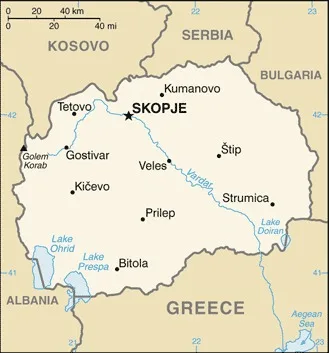
- Southeastern Europe, north of Greece
- Geographic coordinates
- 41 50 N, 22 00 E
- Map references
- Europe
- Area
- total: 25,713 sq kmland: 25,433 sq kmwater: 280 sq km
- Area - comparative
- slightly larger than Vermont; almost four times the size of Delaware
- Land boundaries
- total: 838 kmborder countries: Albania 181 km; Bulgaria 162 km; Greece 234 km; Kosovo 160 km; Serbia 101 km
- Coastline
- 0 km (landlocked)
- Maritime claims
- none (landlocked)
- Climate
- warm, dry summers and autumns; relatively cold winters with heavy snowfall
- Terrain
- mountainous with deep basins and valleys; three large lakes, each divided by a frontier line; country bisected by the Vardar River
- Elevation
- highest point: Golem Korab (Maja e Korabit) 2,764 mlowest point: Vardar River 50 mmean elevation: 741 m
- Natural resources
- low-grade iron ore, copper, lead, zinc, chromite, manganese, nickel, tungsten, gold, silver, asbestos, gypsum, timber, arable land
- Land use
- agricultural land: 49.6% (2023 est.)agricultural land: arable land: arable land: 16.5% (2023 est.)agricultural land: permanent crops: permanent crops: 1.6% (2023 est.)agricultural land: permanent pasture: permanent pasture: 31.5% (2023 est.)forest: 40.9% (2023 est.)other: 9.5% (2023 est.)
- Irrigated land
- 844 sq km (2016)
- Major watersheds (area sq km)
- Atlantic Ocean drainage: (Black Sea) Danube (795,656 sq km)
- Population distribution
- a fairly even distribution throughout most of the country, with urban areas attracting larger and denser populations
- Natural hazards
- high seismic risks
- Geography - note
- landlocked; major transportation corridor from Western and Central Europe to Aegean Sea and Southern Europe to Western Europe
People and Society 34 fields
- Population
- total: 2,137,556 (2025 est.)male: 1,065,634female: 1,071,922
- Nationality
- noun: Macedonian(s)adjective: Macedonian
- Ethnic groups
- Macedonian 58.4%, Albanian 24.3%, Turkish 3.9%, Romani 2.5%, Serb 1.3%, other 2.3%, no ethnic affiliation data available 7.2% (2021 est.)
note: data represent total resident population; Romani populations are usually underestimated in official statistics and may represent 6.5–13% of North Macedonia’s population - Languages
- Languages: Macedonian (official) 61.4%, Albanian (official) 24.3%, Turkish 3.4%, Romani 1.7%, other (includes Aromanian (Vlach) and Bosnian) 2%, unspecified 7.2% (2021 est.)major-language sample(s):
Книга на Светски Факти, неопходен извор на основни информации. (Macedonian)
The World Factbook, the indispensable source for basic information. - Religions
- Orthodox 46.1%, Islam 32.2%, Christian 13.2%, Other 7.2%; less than 1%: atheist, Catholic, other religions, not specified, Protestant (2021 est.)
- Age structure
- 0-14 years: 16% (male 176,423/female 164,945)15-64 years: 68.4% (male 740,649/female 719,627)65 years and over: 15.6% (2024 est.) (male 147,655/female 186,323)
- Dependency ratios
- total dependency ratio: 46.9 (2025 est.)youth dependency ratio: 23.3 (2025 est.)elderly dependency ratio: 23.6 (2025 est.)potential support ratio: 4.2 (2025 est.)
- Median age
- total: 40.9 years (2025 est.)male: 39.4 yearsfemale: 41.6 years
- Population growth rate
- 0.08% (2025 est.)
- Birth rate
- 10.07 births/1,000 population (2025 est.)
- Death rate
- 9.62 deaths/1,000 population (2025 est.)
- Net migration rate
- 0.38 migrant(s)/1,000 population (2025 est.)
- Population distribution
- a fairly even distribution throughout most of the country, with urban areas attracting larger and denser populations
- Urbanization
- urban population: 59.5% of total population (2023)rate of urbanization: 0.61% annual rate of change (2020-25 est.)
- Major urban areas - population
- 611,000 SKOPJE (capital) (2023)
- Sex ratio
- at birth: 1.07 male(s)/female0-14 years: 1.07 male(s)/female15-64 years: 1.03 male(s)/female65 years and over: 0.79 male(s)/femaletotal population: 0.99 male(s)/female (2024 est.)
- Mother's mean age at first birth
- 26.9 years (2020 est.)
- Maternal mortality ratio
- 3 deaths/100,000 live births (2023 est.)
- Infant mortality rate
- total: 6.8 deaths/1,000 live births (2025 est.)male: 7.9 deaths/1,000 live birthsfemale: 6 deaths/1,000 live births
- Life expectancy at birth
- total population: 77.3 years (2024 est.)male: 75.3 yearsfemale: 79.6 years
- Total fertility rate
- 1.53 children born/woman (2025 est.)
- Gross reproduction rate
- 0.74 (2025 est.)
- Drinking water source
- improved: urban: urban: 98.1% of population (2022 est.)improved: rural: rural: 97.4% of population (2022 est.)improved: total: total: 97.8% of population (2022 est.)unimproved: urban: urban: 1.9% of population (2022 est.)unimproved: rural: rural: 2.6% of population (2022 est.)unimproved: total: total: 2.2% of population (2022 est.)
- Health expenditure
- Health expenditure (as % of GDP): 8.5% of GDP (2021)Health expenditure (as % of national budget): 12.4% of national budget (2022 est.)
- Physician density
- 2.94 physicians/1,000 population (2022)
- Hospital bed density
- 4.2 beds/1,000 population (2020 est.)
- Sanitation facility access
- improved: urban: urban: 100% of population (2022 est.)improved: rural: rural: 98.6% of population (2022 est.)improved: total: total: 99.4% of population (2022 est.)unimproved: urban: urban: 0% of population (2022 est.)unimproved: rural: rural: 1.4% of population (2022 est.)unimproved: total: total: 0.6% of population (2022 est.)
- Obesity - adult prevalence rate
- 22.4% (2016)
- Alcohol consumption per capita
- total: 3.9 liters of pure alcohol (2019 est.)beer: 1.93 liters of pure alcohol (2019 est.)wine: 1.03 liters of pure alcohol (2019 est.)spirits: 0.9 liters of pure alcohol (2019 est.)other alcohols: 0.03 liters of pure alcohol (2019 est.)
- Children under the age of 5 years underweight
- 0.9% (2019 est.)
- Currently married women (ages 15-49)
- 66.1% (2021 est.)
- Child marriage
- women married by age 15: 0.3% (2019)women married by age 18: 7.5% (2019)
- Literacy
- female: 97.8% (2018 est.)
- School life expectancy (primary to tertiary education)
- total: 15 years (2022 est.)male: 14 years (2022 est.)female: 15 years (2022 est.)
Environment 10 fields
- Environmental issues
- air pollution from metallurgical plants, smoke from wood-burning stoves, and vehicle emissions
- International environmental agreements
- party to: Air Pollution, Air Pollution-Heavy Metals, Air Pollution-Multi-effect Protocol, Air Pollution-Nitrogen Oxides, Air Pollution-Persistent Organic Pollutants, Air Pollution-Sulphur 85, Air Pollution-Sulphur 94, Air Pollution-Volatile Organic Compounds, Biodiversity, Climate Change, Climate Change-Kyoto Protocol, Climate Change-Paris Agreement, Comprehensive Nuclear Test Ban, Desertification, Endangered Species, Hazardous Wastes, Law of the Sea, Ozone Layer Protection, Wetlandssigned, but not ratified: none of the selected agreements
- Climate
- warm, dry summers and autumns; relatively cold winters with heavy snowfall
- Land use
- agricultural land: 49.6% (2023 est.)agricultural land: arable land: arable land: 16.5% (2023 est.)agricultural land: permanent crops: permanent crops: 1.6% (2023 est.)agricultural land: permanent pasture: permanent pasture: 31.5% (2023 est.)forest: 40.9% (2023 est.)other: 9.5% (2023 est.)
- Urbanization
- urban population: 59.5% of total population (2023)rate of urbanization: 0.61% annual rate of change (2020-25 est.)
- Carbon dioxide emissions
- total emissions: 7.369 million metric tonnes of CO2 (2023 est.)from coal and metallurgical coke: 3.014 million metric tonnes of CO2 (2023 est.)from petroleum and other liquids: 3.682 million metric tonnes of CO2 (2023 est.)from consumed natural gas: 673,000 metric tonnes of CO2 (2023 est.)
- Particulate matter emissions
- 28.7 micrograms per cubic meter (2019 est.)
- Waste and recycling
- municipal solid waste generated annually: 627,000 tons (2024 est.)percent of municipal solid waste recycled: 4.9% (2022 est.)
- Total water withdrawal
- municipal: 305.4 million cubic meters (2022 est.)industrial: 31.54 million cubic meters (2022 est.)agricultural: 139 million cubic meters (2022 est.)
- Total renewable water resources
- 6.4 billion cubic meters (2022 est.)
Government 23 fields
- Country name
- conventional long form: Republic of North Macedoniaconventional short form: North Macedonialocal long form: Republika Severna Makedonijalocal short form: Severna Makedonijaformer: Democratic Federal Macedonia, People's Republic of Macedonia, Socialist Republic of Macedonia, Republic of Macedoniaetymology: the name derives from the ancient kingdom of Macedon (7th to 2nd centuries B.C.), whose name origin is unclear; it may derive from the mythological Macedon, the son of the Greek god Zeus; alternatively, it may come from the Greek word makednos, meaning "tail," or the Illyrian word maketia, meaning "cattle"
- Government type
- parliamentary republic
- Capital
- name: Skopjegeographic coordinates: 42 00 N, 21 26 Etime difference: UTC+1 (6 hours ahead of Washington, DC, during Standard Time)daylight saving time: +1hr, begins last Sunday in March; ends last Sunday in Octoberetymology: the name is of Illyrian or Macedonian origin, and the meaning is unclear; derives from Scupi, its name during the Roman era
- Administrative divisions
- 80 municipalities (opstini, singular - opstina) and 1 city* (grad); Aracinovo, Berovo, Bitola, Bogdanci, Bogovinje, Bosilovo, Brvenica, Caska, Centar Zupa, Cesinovo-Oblesevo, Cucer Sandevo, Debar, Debarca, Delcevo, Demir Hisar, Demir Kapija, Dojran, Dolneni, Gevgelija, Gostivar, Gradsko, Ilinden, Jegunovce, Karbinci, Kavadarci, Kicevo, Kocani, Konce, Kratovo, Kriva Palanka, Krivogastani, Krusevo, Kumanovo, Lipkovo, Lozovo, Makedonska Kamenica, Makedonski Brod, Mavrovo i Rostuse, Mogila, Negotino, Novaci, Novo Selo, Ohrid, Pehcevo, Petrovec, Plasnica, Prilep, Probistip, Radovis, Rankovce, Resen, Rosoman, Skopje*, Sopiste, Staro Nagoricane, Stip, Struga, Strumica, Studenicani, Sveti Nikole, Tearce, Tetovo, Valandovo, Vasilevo, Veles, Vevcani, Vinica, Vrapciste, Zelenikovo, Zelino, Zrnovci
*the Greater Skopje area is composed of 10 municipalities: Aerodrom, Butel, Centar, Chair, Gazi Baba, Gjorce Petrov, Karposh, Kisela Voda, Saraj, and Shuto Orizari - Legal system
- civil law system; judicial review of legislative acts
- Constitution
- history: several previous (since 1944); latest adopted 17 November 1991, effective 20 November 1991amendment process: proposed by the president of the republic, by the government, by at least 30 members of the Assembly, or by petition of at least 150,000 citizens; final approval requires a two-thirds majority vote by the Assembly
- International law organization participation
- has not submitted an ICJ jurisdiction declaration; accepts ICCt jurisdiction
- Citizenship
- citizenship by birth: nocitizenship by descent only: at least one parent must be a citizen of North Macedoniadual citizenship recognized: noresidency requirement for naturalization: 8 years
- Suffrage
- 18 years of age; universal
- Executive branch
- chief of state: President Gordana SILJANOVSKA-DAVKOVA (since 12 May 2024)head of government: Prime Minister Hristijan MICKOSKI (since 23 June 2024)cabinet: Council of Ministers elected by the Assembly by simple majority voteelection/appointment process: president directly elected using a modified 2-round system; a candidate can only be elected in the first round with an absolute majority from all registered voters; in the second round, voter turnout must be at least 40% for the result to be valid; president elected for a 5-year term (eligible for a second term); following legislative elections, the Assembly usually elects the leader of the majority party or majority coalition as prime ministermost recent election date: 24 April and 8 May 2024election results:
2024: Hristijan MICKOSKI elected prime minister; Assembly vote - 77 for, 22 against
2024: Gordana SILJANOVSKA-DAVKOVA elected president in the second round; percent of vote - Gordana SILJANOVSKA-DAVKOVA (VMRO-DPMNE) 69%, Stevo PENDAROVSKI (SDSM) 31%
2024: Talat XHAFERI elected caretaker prime minister; Assembly vote - 65 for (opposition boycott)
2022: Dimitar KOVACEVSKI elected prime minister; Assembly vote - NAexpected date of next election: 2029 - Legislative branch
- legislature name: Assembly of the Republic (Sobranie)legislative structure: unicameralnumber of seats: 123 (all directly elected)electoral system: mixed systemscope of elections: full renewalterm in office: 4 yearsmost recent election date: 5/8/2024parties elected and seats per party: Coalition "Your Macedonia" (led by VMRO-DPMNE) (58); Coalition "European Front" (led by the Democratic Union for Integration – DUI) (18); Coalition "For a European Future" (led by the Social Democratic Union of Macedonia – SDSM) (18); Coalition VLEN (14); ZNAM (Movement "I know": For our Macedonia) (6); The Left (Levica) (6)percentage of women in chamber: 39.2%expected date of next election: May 2028
- Judicial branch
- highest court(s): Supreme Court (consists of 22 judges); Constitutional Court (consists of 9 judges)judge selection and term of office: Supreme Court judges nominated by the Judicial Council, a 7-member body of legal professionals, and appointed by the Assembly; judge tenure NA; Constitutional Court judges appointed by the Assembly for nonrenewable, 9-year termssubordinate courts: Courts of Appeal; Basic Courts
- Political parties
- Alliance for Albanians or AfA or ASH
Alternative (Alternativa) or AAA
Besa Movement or BESA
Citizen Option for Macedonia or GROM
Democratic Alliance or DS
Democratic Movement or LD
Democratic Party of Albanians or PDSH
Democratic Party of Serbs or DPSM
Democratic Renewal of Macedonia or DOM
Democratic Union for Integration or BDI
European Democratic Party or PDE
Internal Macedonian Revolutionary Organization - Democratic Party for Macedonian National Unity or VMRO-DPMNE
Internal Macedonian Revolutionary Organization - People's Party or VMRO-NP
Liberal Democratic Party or LDP
New Social-Democratic Party or NSDP
Social Democratic Union of Macedonia or SDSM
Socialist Party of Macedonia or SPM
Srpska Stranka in Macedonia or SSM
The Left (Levica)
The People Movement or LP
Turkish Democratic Party or TDP
Turkish Movement Party or THP
We Can! (coalition includes SDSM/BESA/VMRO-NP, DPT, LDP) - Diplomatic representation in the US
- chief of mission: Ambassador Zoran POPOV (since 16 September 2022)chancery: 2129 Wyoming Avenue NW, Washington, DC 20008telephone: [1] (202) 667-0501FAX: [1] (202) 667-2104email address and website:
[email protected]
United States (mfa.gov.mk)consulate(s) general: Chicago, Detroit, New York - Diplomatic representation from the US
- chief of mission: Ambassador Angela AGGELER (since 8 November 2022)embassy: Str. Samoilova, Nr. 21, 1000 Skopjemailing address: 7120 Skopje Place, Washington, DC 20521-7120telephone: [389] (2) 310-2000FAX: [389] (2) 310-2499email address and website:
[email protected]
https://mk.usembassy.gov/ - International organization participation
- BIS, CD, CE, CEI, EAPC, EBRD, EU (candidate country), FAO, IAEA, IBRD, ICAO, ICC (NGOs), ICCt, ICRM, IDA, IFAD, IFC, IFRCS, ILO, IMF, IMO, Interpol, IOC, IOM, IPU, ISO, ITU, ITUC (NGOs), MIGA, NATO, OAS (observer), OIF, OPCW, OSCE, PCA, PFP, SELEC, UN, UNCTAD, UNESCO, UNHCR, UNIDO, UNIFIL, UNWTO, UPU, WCO, WHO, WIPO, WMO, WTO
note: North Macedonia is an EU candidate country whose satisfactory completion of accession criteria is required before being granted full EU membership - Independence
- 8 September 1991 (referendum endorsed independence from Yugoslavia)
- National holiday
- Independence Day, 8 September (1991), also known as National Day
- Flag
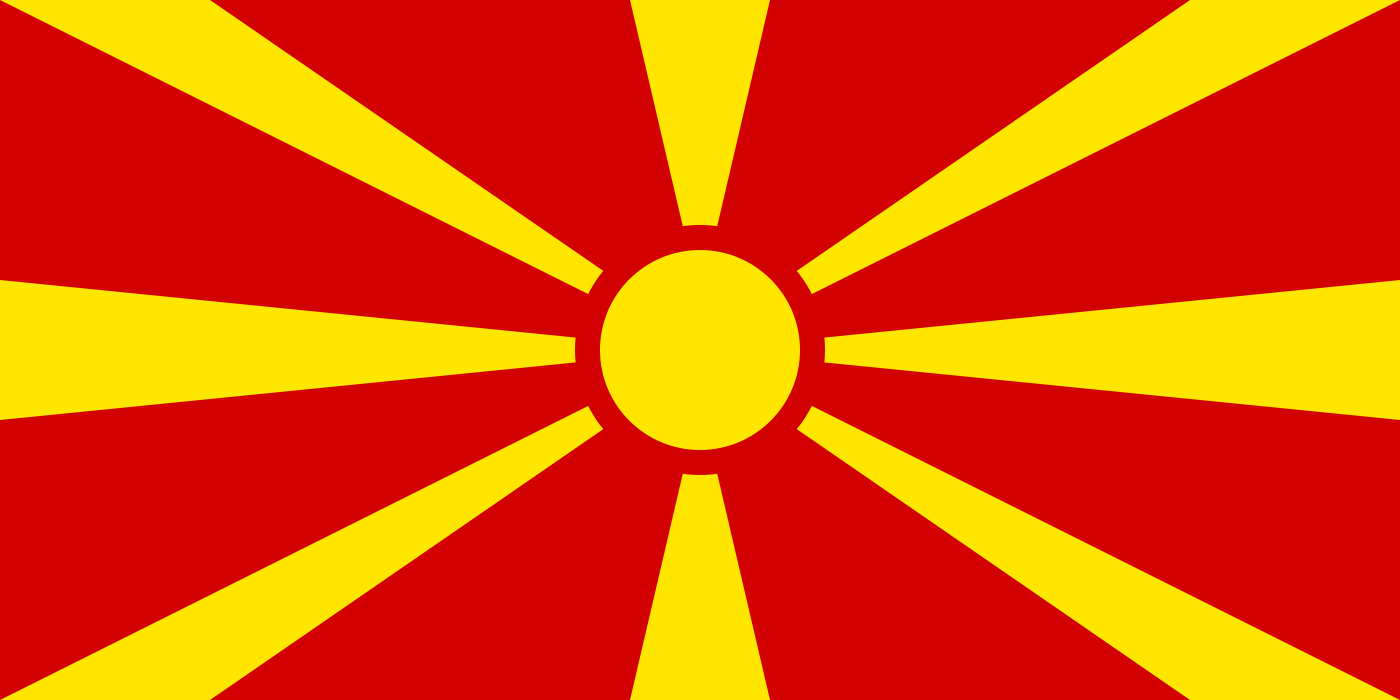
- description: a red field with a yellow sun (the Sun of Liberty) in the center, with eight broadening rays extending to the edges
meaning: the red and yellow colors have long been associated with Macedonia - National symbol(s)
- eight-rayed sun
- National color(s)
- red, yellow
- National anthem(s)
- title: "Denes nad Makedonija" (Today Over Macedonia)lyrics/music: Vlado MALESKI/Todor SKALOVSKIhistory: written in 1943 and adopted in 1991, the song previously served as the anthem of the Socialist Republic of Macedonia, when it was part of Yugoslavia
- National heritage
- total World Heritage Sites: 2 (both natural)selected World Heritage Site locales: Natural and Cultural Heritage of the Ohrid Region; Ancient and Primeval Beech Forests of the Carpathians
Economy 32 fields
- Economic overview
- upper-middle-income European economy; GDP growth driven by private consumption, public infrastructure investments, and wage growth; stalled progress on EU accession; public debt rising due to high pensions, wages, and interest payments; structural challenges of emigration, low productivity growth, and governance
- Real GDP (purchasing power parity)
- Real GDP (purchasing power parity) 2024: $43.844 billion (2024 est.)Real GDP (purchasing power parity) 2023: $42.668 billion (2023 est.)Real GDP (purchasing power parity) 2022: $41.801 billion (2022 est.)
- Real GDP growth rate
- Real GDP growth rate 2024: 2.8% (2024 est.)Real GDP growth rate 2023: 2.1% (2023 est.)Real GDP growth rate 2022: 2.8% (2022 est.)
- Real GDP per capita
- Real GDP per capita 2024: $24,500 (2024 est.)Real GDP per capita 2023: $23,300 (2023 est.)Real GDP per capita 2022: $22,800 (2022 est.)
- GDP (official exchange rate)
- $16.685 billion (2024 est.)
note: data in current dollars at official exchange rate - Inflation rate (consumer prices)
- Inflation rate (consumer prices) 2024: 3.5% (2024 est.)Inflation rate (consumer prices) 2023: 9.4% (2023 est.)Inflation rate (consumer prices) 2022: 14.2% (2022 est.)
- GDP - composition, by sector of origin
- agriculture: 6% (2024 est.)industry: 22.7% (2024 est.)services: 59.2% (2024 est.)
- GDP - composition, by end use
- household consumption: 67.9% (2024 est.)government consumption: 16.8% (2024 est.)investment in fixed capital: 28.4% (2024 est.)investment in inventories: 0% (2024 est.)exports of goods and services: 62.7% (2024 est.)imports of goods and services: -75.8% (2024 est.)
- Agricultural products
- chillies/peppers, milk, wheat, potatoes, grapes, barley, cabbages, maize, watermelons, tomatoes (2023)
note: top ten agricultural products based on tonnage - Industries
- food processing, beverages, textiles, chemicals, iron, steel, cement, energy, pharmaceuticals, automotive parts
- Industrial production growth rate
- 1.8% (2024 est.)
note: annual % change in industrial value added based on constant local currency - Labor force
- 779,200 (2024 est.)
note: number of people ages 15 or older who are employed or seeking work - Unemployment rate
- Unemployment rate 2024: 13.5% (2024 est.)Unemployment rate 2023: 13.2% (2023 est.)Unemployment rate 2022: 14.5% (2022 est.)
- Youth unemployment rate (ages 15-24)
- total: 30.3% (2024 est.)male: 29.2% (2024 est.)female: 32.3% (2024 est.)
- Population below poverty line
- 21.8% (2019 est.)
note: % of population with income below national poverty line - Gini Index coefficient - distribution of family income
- Gini Index coefficient - distribution of family income 2019: 33.5 (2019 est.)
- Average household expenditures
- on food: 30.6% of household expenditures (2023 est.)on alcohol and tobacco: 4.8% of household expenditures (2023 est.)
- Household income or consumption by percentage share
- lowest 10%: 1.9% (2019 est.)highest 10%: 22.9% (2019 est.)
- Remittances
- Remittances 2024: 2.7% of GDP (2024 est.)Remittances 2023: 2.9% of GDP (2023 est.)Remittances 2022: 3.3% of GDP (2022 est.)
- Budget
- revenues: $4.787 billion (2023 est.)expenditures: $5.514 billion (2023 est.)
- Public debt
- Public debt 2017: 39.3% of GDP (2017 est.)
- Taxes and other revenues
- 17.9% (of GDP) (2023 est.)
note: central government tax revenue as a % of GDP - Current account balance
- Current account balance 2024: -$374.385 million (2024 est.)Current account balance 2023: $56.573 million (2023 est.)Current account balance 2022: -$868.965 million (2022 est.)
- Exports
- Exports 2024: $10.445 billion (2024 est.)Exports 2023: $10.691 billion (2023 est.)Exports 2022: $10.123 billion (2022 est.)
- Exports - partners
- Germany 39%, Serbia 8%, Bulgaria 6%, Greece 5%, Czechia 3% (2023)
note: top five export partners based on percentage share of exports - Exports - commodities
- reaction and catalytic products, insulated wire, electricity, garments, seats (2023)
note: top five export commodities based on value in dollars - Imports
- Imports 2024: $12.644 billion (2024 est.)Imports 2023: $12.748 billion (2023 est.)Imports 2022: $13.009 billion (2022 est.)
- Imports - partners
- UK 12%, Germany 10%, Greece 9%, China 9%, Serbia 8% (2023)
note: top five import partners based on percentage share of imports - Imports - commodities
- platinum, refined petroleum, laboratory ceramic ware, cars, natural gas (2023)
note: top five import commodities based on value in dollars - Reserves of foreign exchange and gold
- Reserves of foreign exchange and gold 2024: $5.252 billion (2024 est.)Reserves of foreign exchange and gold 2023: $5.015 billion (2023 est.)Reserves of foreign exchange and gold 2022: $4.12 billion (2022 est.)
- Debt - external
- Debt - external 2023: $5.637 billion (2023 est.)
- Exchange rates
- Currency: Macedonian denars (MKD) per US dollar -Exchange rates 2024: 56.873 (2024 est.)Exchange rates 2023: 56.947 (2023 est.)Exchange rates 2022: 58.574 (2022 est.)Exchange rates 2021: 52.102 (2021 est.)Exchange rates 2020: 54.144 (2020 est.)
Energy 7 fields
- Electricity access
- electrification - total population: 100% (2022 est.)
- Electricity
- installed generating capacity: 2.467 million kW (2023 est.)consumption: 5.896 billion kWh (2023 est.)exports: 7.081 billion kWh (2023 est.)imports: 7.232 billion kWh (2023 est.)transmission/distribution losses: 993.662 million kWh (2023 est.)
- Electricity generation sources
- fossil fuels: 68.2% of total installed capacity (2023 est.)solar: 4.6% of total installed capacity (2023 est.)wind: 2.3% of total installed capacity (2023 est.)hydroelectricity: 24% of total installed capacity (2023 est.)biomass and waste: 0.8% of total installed capacity (2023 est.)
- Coal
- production: 4 million metric tons (2023 est.)consumption: 5.344 million metric tons (2023 est.)exports: 58,000 metric tons (2023 est.)imports: 41,000 metric tons (2023 est.)proven reserves: 332 million metric tons (2023 est.)
- Petroleum
- refined petroleum consumption: 24,000 bbl/day (2023 est.)
- Natural gas
- consumption: 348.078 million cubic meters (2023 est.)imports: 347.981 million cubic meters (2023 est.)
- Energy consumption per capita
- Total energy consumption per capita 2023: 56.104 million Btu/person (2023 est.)
Communications 6 fields
- Telephones - fixed lines
- total subscriptions: 439,000 (2022 est.)subscriptions per 100 inhabitants: 24 (2022 est.)
- Telephones - mobile cellular
- total subscriptions: 1.98 million (2024 est.)subscriptions per 100 inhabitants: 108 (2024 est.)
- Broadcast media
- public TV broadcaster Macedonian Radio and Television operates 5 national terrestrial TV channels and 2 satellite TV channels; 11 regional TV stations broadcast nationally; 29 regional and local broadcasters; a large number of cable operators offer domestic and international programming; the public radio broadcaster operates 3 stations; 4 privately owned national radio stations and 60 regional and local operators (2023)
- Internet country code
- .mk
- Internet users
- percent of population: 87% (2023 est.)
- Broadband - fixed subscriptions
- total: 515,000 (2022 est.)subscriptions per 100 inhabitants: 28 (2022 est.)
Transportation 4 fields
- Civil aircraft registration country code prefix
- Z3
- Airports
- 13 (2025)
- Heliports
- 13 (2025)
- Railways
- total: 699 km (2020) 313 km electrified
Military and Security 6 fields
- Military and security forces
- Army of the Republic of North Macedonia (ARSM or ARNM): joint force with air, ground, reserve, special operations, and support forces (2025)
note: the Police of Macedonia maintain internal security, including migration and border enforcement, and report to the Ministry of the Interior - Military expenditures
- Military Expenditures 2025: 2% of GDP (2025 est.)Military Expenditures 2024: 1.9% of GDP (2024 est.)Military Expenditures 2023: 1.7% of GDP (2023 est.)Military Expenditures 2022: 1.6% of GDP (2022 est.)Military Expenditures 2021: 1.5% of GDP (2021 est.)
- Military and security service personnel strengths
- approximately 6,000 active military personnel (2025)
- Military equipment inventories and acquisitions
- the military's inventory is a mix of Russian/Soviet-era armaments and growing quantities of more modern equipment from countries such as Türkiye, the UK, and the US (2025)
- Military service age and obligation
- 18 years of age for voluntary military service; conscription abolished in 2007 (2025)
note: as of 2024, women made up about 10% of the military's full-time personnel - Military - note
- the Army of the Republic of North Macedonia (ARSM) is responsible for the defense of the country’s territory and independence, fulfilling North Macedonia’s commitments to NATO and European security, and contributing to EU, NATO, and UN peace and security missions; the ARSM has participated in multinational missions and operations in Afghanistan (NATO), Bosnia and Herzegovina (EU), Eastern Europe (NATO), Iraq (NATO), Kosovo (NATO), and Lebanon (UN); a key area of focus over the past decade has been improving capabilities and bringing the largely Soviet-era-equipped ARSM up to NATO standards; it has increased its participation in NATO training exercises since becoming the 30th member of the Alliance in 2020 and currently has small numbers of combat troops deployed to Bulgaria and Romania as part of NATO’s Enhance Forward Presence mission implemented because of Russian military aggression against Ukraine (2025)
Terrorism 1 field
- Terrorist group(s)
- Islamic State of Iraq and ash-Sham (ISIS)
note: details about the history, aims, leadership, organization, areas of operation, tactics, targets, weapons, size, and sources of support of the group(s) appear(s) in the Terrorism reference guide
Transnational Issues 1 field
- Refugees and internally displaced persons
- refugees: 20,937 (2024 est.)stateless persons: 159 (2024 est.)
Frequently asked
- What is the population of North Macedonia in 2025?
- North Macedonia has a population of 1.82 million (1,820,909) according to World Bank, World Development Indicators data for 2025.
- What is the capital of North Macedonia?
- The capital of North Macedonia is Skopje.
- How large is the economy of North Macedonia?
- North Macedonia's GDP is $19.10B (2025, World Bank, World Development Indicators), which is $10,490 per capita.
- Who leads North Macedonia?
- Head of state: Gordana Siljanovska-Davkova (since May 12, 2024). Head of government: Hristijan Mickoski (since June 23, 2024). Source: Wikidata, checked August 11, 2026.
North Macedonia