South Africa
Republic of South Africa
Updated
Population
64.75 million
2025 · World Bank
GDP
$427.18B
2025 · World Bank
GDP per capita
$6,598
2025 · World Bank
Area
1,221,037 km²
mledoze/countries reference dataset
Capital
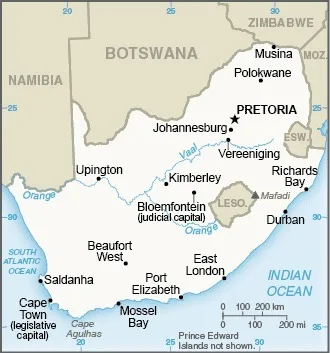
Pretoria, Bloemfontein, Cape Town
Median age
28.7 yrs
2025 · UN WPP
Location
- Capital
- Pretoria, Bloemfontein, Cape Town
- Region
- Africa
- Subregion
- Southern Africa
- Area
- 1,221,037 km²
- Neighbours
- 6
- Languages
- Afrikaans, English, Southern Ndebele, Northern Sotho, Southern Sotho, Swazi, Tswana, Tsonga, Venda, Xhosa, Zulu
Leadership
- Head of state
- Cyril Ramaphosa
- In office since February 15, 2018
Wikidata (CC0), checked August 11, 2026. Frozen Factbook mirrors still list the officeholders of January 2026.
Then and now
The CIA World Factbook stopped updating in January 2026. This is what has changed since its final edition.
| Indicator | Factbook, final edition | Current | Change |
|---|---|---|---|
| Population | 61,089,9262025 | 64,747,3192025 | +6.0% |
| GDP (nominal) | $400.26B2024 | $427.18B2025 | +6.7% |
| Inflation rate | 4.4%2024 | 3.2%2025 | -1.2 pp |
Trends since 2000
World Bank, World Development Indicators (CC BY 4.0).
7 facts about South Africa
- 01 South Africa ranks 24 of 238 in population, with 64.75 million people as of 2025.
- 02 Its economy produced $427.18B in 2025, or $6,598 per person.
- 03 It shares land borders with 6 neighbours: Botswana, Lesotho, Mozambique, Namibia, Eswatini, Zimbabwe.
- 04 Population has grown 37% since 2000, from 47.16 million to 64.75 million.
- 05 Prices sit at about 41% of United States levels (World Bank PPP data, 2025).
- 06 78% of the population uses the internet (2024).
- 07 It lists 11 official or major languages: Afrikaans, English, Southern Ndebele, Northern Sotho, Southern Sotho, Swazi, Tswana, Tsonga, Venda, Xhosa, Zulu.
Reference
- Languages
- Afrikaans, English, Southern Ndebele, Northern Sotho, Southern Sotho, Swazi, Tswana, Tsonga, Venda, Xhosa, Zulu
- Currency
- South African rand (ZAR)
- Calling code
- +27
- Internet TLD
- .za
- Demonym
- South African
- ISO codes
- ZA · ZAF · 710
Compare South Africa
- South Africa vs Mozambique
- South Africa vs Zimbabwe
- South Africa vs Namibia
- South Africa vs Botswana
- South Africa vs Lesotho
- South Africa vs Eswatini
- South Africa vs Egypt
- South Africa vs India
- South Africa vs China
- South Africa vs United States
- South Africa vs Indonesia
- South Africa vs Pakistan
- South Africa vs Brazil
- South Africa vs Bangladesh
- South Africa vs Russia
- South Africa vs Mexico
- South Africa vs Japan
- South Africa vs Philippines
- South Africa vs Vietnam
- South Africa vs Iran
- South Africa vs Turkey (Türkiye)
- South Africa vs Germany
- South Africa vs Thailand
- South Africa vs United Kingdom
The Factbook archive 155 fields · 13 categories
The complete World Factbook entry for South Africa: 155 fields and 276 sub-entries across 13 categories, kept whole as historical reference. A United States Government work in the public domain, reflecting data as of the final January 2026 edition; the live figures above supersede the fast-moving numbers in it. Last CIA update: January 18, 2026.
Introduction 1 field
- Background
- Some of the earliest human remains in the fossil record were found in South Africa. By about A.D. 500, Bantu-speaking groups began settling into what is now northeastern South Africa, displacing Khoisan-speaking groups to the southwest. Dutch traders landed at the southern tip of present-day South Africa in 1652 and established a stopover point on the spice route between the Netherlands and the Far East, founding the city of Cape Town. After the British seized the Cape of Good Hope area in 1806, many settlers of Dutch descent -- known then as "Boers," or farmers, but later called Afrikaners -- trekked north to found their own republics, Transvaal and Orange Free State. In the 1820s, several decades of wars began as the Zulus expanded their territory, moving out of what is today southeastern South Africa and clashing with other indigenous peoples and the growing European settlements. The discovery of diamonds (1867) and gold (1886) spurred mass immigration, predominantly from Europe.
The Zulu kingdom's territory was incorporated into the British Empire after the Anglo-Zulu War in 1879, and the Afrikaner republics were incorporated after their defeat in the Second South African War (1899-1902). Beginning in 1910, the British and the Afrikaners ruled together under the Union of South Africa, which left the British Commonwealth to become a fully self-governing republic in 1961 after a Whites-only referendum. In 1948, the National Party was voted into power and instituted a policy of apartheid -– billed as "separate development" of the races -- which favored the White minority and suppressed the Black majority and other non-White groups. The African National Congress (ANC) led the resistance to apartheid, and many top ANC leaders such as Nelson MANDELA spent decades in South Africa's prisons. Internal protests and insurgency, as well as boycotts from some Western nations and institutions, led to the regime's eventual willingness to unban the ANC and negotiate a peaceful transition to majority rule. The first multi-racial elections in 1994 ushered in majority rule under an ANC-led government. South Africa has since struggled to address apartheid-era imbalances in wealth, housing, education, and health care under successive administrations. President Cyril RAMAPHOSA, who was reelected as the ANC leader in 2022, has made some progress in reigning in corruption.
Geography 20 fields
- Location
- Southern Africa, at the southern tip of the continent of Africa
- Geographic coordinates
- 29 00 S, 24 00 E
- Map references
- Africa
- Area
- total: 1,219,090 sq kmland: 1,214,470 sq kmwater: 4,620 sq km
- Area - comparative
- slightly less than twice the size of Texas
- Land boundaries
- total: 5,244 kmborder countries: Botswana 1,969 km; Lesotho 1,106 km; Mozambique 496 km; Namibia 1,005 km; Eswatini 438 km; Zimbabwe 230 km
- Coastline
- 2,798 km
- Maritime claims
- territorial sea: 12 nmcontiguous zone: 24 nmexclusive economic zone: 200 nmcontinental shelf: 200 nm or to edge of the continental margin
- Climate
- mostly semiarid; subtropical along east coast; sunny days, cool nights
- Terrain
- vast interior plateau rimmed by rugged hills and narrow coastal plain
- Elevation
- highest point: Ntheledi (Mafadi) 3,450 mlowest point: Atlantic/Indian Oceans 0 mmean elevation: 1,034 m
- Natural resources
- gold, chromium, antimony, coal, iron ore, manganese, nickel, phosphates, tin, rare earth elements, uranium, gem diamonds, platinum, copper, vanadium, salt, natural gas
note: South Africa was the World's leading chromite ore producer in 2022 with an output of 18,000 mt - Land use
- agricultural land: 79.4% (2023 est.)agricultural land: arable land: arable land: 9.9% (2023 est.)agricultural land: permanent crops: permanent crops: 0.3% (2023 est.)agricultural land: permanent pasture: permanent pasture: 69.2% (2023 est.)forest: 18.7% (2023 est.)other: 1.9% (2023 est.)
- Irrigated land
- 16,700 sq km (2012)
- Major rivers (by length in km)
- Orange (shared with Lesotho [s], and Namibia [m]) - 2,092 km; Limpoporivier (Limpopo) river source (shared with Botswana, Zimbabwe, and Mozambique [m]) - 1,800 km; Vaal [s] - 1,210 km
note: [s] after country name indicates river source; [m] after country name indicates river mouth - Major watersheds (area sq km)
- Atlantic Ocean drainage: Orange (941,351 sq km)
- Major aquifers
- Karoo Basin, Lower Kalahari-Stampriet Basin
- Population distribution
- the population is concentrated along the southern and southeastern coast, and inland around Pretoria; the eastern half of the country is more densely populated than the west, as shown in this population distribution map
- Natural hazards
- prolonged droughts
volcanism: the volcano that formed Marion Island in the Prince Edward Islands is South Africa's only active volcano - Geography - note
- note 1: South Africa completely surrounds Lesotho and almost completely surrounds Eswatini
note 2: sometimes mistaken for the southernmost point of Africa, the Cape of Good Hope is more accurately described as the southwestern-most point of the African continent; Cape Agulhas, the meeting point of the Atlantic and Indian Oceans, is the southernmost point of the African continent
People and Society 34 fields
- Population
- total: 61,089,926 (2025 est.)male: 29,989,969female: 31,099,957
- Nationality
- noun: South African(s)adjective: South African
- Ethnic groups
- Black African 80.9%, Colored 8.8%, White 7.8%, Indian/Asian 2.6% (2021 est.)
note: Colored is a term used in South Africa, including on the national census, for persons of mixed race ancestry who developed a distinct cultural identity over several hundred years - Languages
- Languages: isiZulu or Zulu (official) 25.3%, isiXhosa or Xhosa (official) 14.8%, Afrikaans (official) 12.2%, Sepedi or Pedi (official) 10.1%, Setswana or Tswana (official) 9.1%, English (official) 8.1%, Sesotho or Sotho (official) 7.9%, Xitsonga or Tsonga (official) 3.6%, siSwati or Swati (official) 2.8%, Tshivenda or Venda (official) 2.5%, isiNdebele or Ndebele (official) 1.6%, other (includes South African sign language (official) and Khoi or Khoisan or Khoe languages) 2% (2018 est.)major-language sample(s):
Die Wereld Feite Boek, n’ onontbeerlike bron vir basiese informasie. (Afrikaans)
The World Factbook, the indispensable source for basic information. (English) - Religions
- Christian 86%, ancestral, tribal, animist, or other traditional African religions 5.4%, Muslim 1.9%, other 1.5%, nothing in particular 5.2% (2015 est.)
- Age structure
- 0-14 years: 27.2% (male 8,227,690/female 8,194,392)15-64 years: 65.3% (male 19,524,873/female 19,947,839)65 years and over: 7.5% (2024 est.) (male 1,911,825/female 2,636,028)
- Dependency ratios
- total dependency ratio: 53 (2025 est.)youth dependency ratio: 41.1 (2025 est.)elderly dependency ratio: 11.8 (2025 est.)potential support ratio: 8.4 (2025 est.)
- Median age
- total: 30.7 years (2025 est.)male: 30.1 yearsfemale: 30.6 years
- Population growth rate
- 1.06% (2025 est.)
- Birth rate
- 17.21 births/1,000 population (2025 est.)
- Death rate
- 6.56 deaths/1,000 population (2025 est.)
- Net migration rate
- -0.07 migrant(s)/1,000 population (2025 est.)
- Population distribution
- the population is concentrated along the southern and southeastern coast, and inland around Pretoria; the eastern half of the country is more densely populated than the west, as shown in this population distribution map
- Urbanization
- urban population: 68.8% of total population (2023)rate of urbanization: 1.72% annual rate of change (2020-25 est.)
- Major urban areas - population
- 10.316 million Johannesburg (includes Ekurhuleni), 4.890 million Cape Town (legislative capital), 3.228 million Durban, 2.818 million PRETORIA (administrative capital), 1.296 million Port Elizabeth, 934,000 West Rand (2023)
- Sex ratio
- at birth: 1.02 male(s)/female0-14 years: 1 male(s)/female15-64 years: 0.98 male(s)/female65 years and over: 0.73 male(s)/femaletotal population: 0.96 male(s)/female (2024 est.)
- Maternal mortality ratio
- 118 deaths/100,000 live births (2023 est.)
- Infant mortality rate
- total: 19.7 deaths/1,000 live births (2025 est.)male: 23.9 deaths/1,000 live birthsfemale: 20 deaths/1,000 live births
- Life expectancy at birth
- total population: 71.9 years (2024 est.)male: 70.3 yearsfemale: 73.5 years
- Total fertility rate
- 2.23 children born/woman (2025 est.)
- Gross reproduction rate
- 1.1 (2025 est.)
- Drinking water source
- improved: urban: urban: 99.1% of population (2022 est.)improved: rural: rural: 84.5% of population (2022 est.)improved: total: total: 94.5% of population (2022 est.)unimproved: urban: urban: 0.9% of population (2022 est.)unimproved: rural: rural: 15.5% of population (2022 est.)unimproved: total: total: 5.5% of population (2022 est.)
- Health expenditure
- Health expenditure (as % of GDP): 8.3% of GDP (2021)Health expenditure (as % of national budget): 16.9% of national budget (2022 est.)
- Physician density
- 0.79 physicians/1,000 population (2022)
- Sanitation facility access
- improved: urban: urban: 95.9% of population (2022 est.)improved: rural: rural: 81.7% of population (2022 est.)improved: total: total: 91.4% of population (2022 est.)unimproved: urban: urban: 4.1% of population (2022 est.)unimproved: rural: rural: 18.3% of population (2022 est.)unimproved: total: total: 8.6% of population (2022 est.)
- Obesity - adult prevalence rate
- 28.3% (2016)
- Alcohol consumption per capita
- total: 7.21 liters of pure alcohol (2019 est.)beer: 3.99 liters of pure alcohol (2019 est.)wine: 1.21 liters of pure alcohol (2019 est.)spirits: 1.31 liters of pure alcohol (2019 est.)other alcohols: 0.7 liters of pure alcohol (2019 est.)
- Tobacco use
- total: 20.1% (2025 est.)male: 35.3% (2025 est.)female: 6% (2025 est.)
- Children under the age of 5 years underweight
- 4.9% (2017 est.)
- Currently married women (ages 15-49)
- 33.6% (2020 est.)
- Child marriage
- women married by age 15: 0.9% (2016)women married by age 18: 3.6% (2016)men married by age 18: 0.6% (2016)
- Education expenditure
- Education expenditure (% GDP): 6% of GDP (2024 est.)Education expenditure (% national budget): 19.1% national budget (2025 est.)
- Literacy
- total population: 91.2% (2024 est.)male: 91.5% (2024 est.)female: 90.8% (2024 est.)
- School life expectancy (primary to tertiary education)
- total: 14 years (2022 est.)male: 14 years (2022 est.)female: 14 years (2022 est.)
Environment 11 fields
- Environmental issues
- limited freshwater resources due to lack of major rivers or lakes; pollution of rivers from agricultural runoff and urban waste; air pollution resulting in acid rain; deforestation; soil erosion; land degradation; desertification; solid waste pollution; significant floral extinctions
- International environmental agreements
- party to: Antarctic-Environmental Protection, Antarctic-Marine Living Resources, Antarctic Seals, Antarctic Treaty, Biodiversity, Climate Change, Climate Change-Kyoto Protocol, Climate Change-Paris Agreement, Comprehensive Nuclear Test Ban, Desertification, Endangered Species, Hazardous Wastes, Law of the Sea, Marine Dumping-London Convention, Marine Dumping-London Protocol, Marine Life Conservation, Nuclear Test Ban, Ozone Layer Protection, Ship Pollution, Wetlands, Whalingsigned, but not ratified: none of the selected agreements
- Climate
- mostly semiarid; subtropical along east coast; sunny days, cool nights
- Land use
- agricultural land: 79.4% (2023 est.)agricultural land: arable land: arable land: 9.9% (2023 est.)agricultural land: permanent crops: permanent crops: 0.3% (2023 est.)agricultural land: permanent pasture: permanent pasture: 69.2% (2023 est.)forest: 18.7% (2023 est.)other: 1.9% (2023 est.)
- Urbanization
- urban population: 68.8% of total population (2023)rate of urbanization: 1.72% annual rate of change (2020-25 est.)
- Carbon dioxide emissions
- total emissions: 446.704 million metric tonnes of CO2 (2023 est.)from coal and metallurgical coke: 365.269 million metric tonnes of CO2 (2023 est.)from petroleum and other liquids: 73.913 million metric tonnes of CO2 (2023 est.)from consumed natural gas: 7.522 million metric tonnes of CO2 (2023 est.)
- Particulate matter emissions
- 17 micrograms per cubic meter (2019 est.)
- Methane emissions
- energy: 1,489.2 kt (2022-2024 est.)agriculture: 754.2 kt (2019-2021 est.)waste: 770.2 kt (2019-2021 est.)other: 32.1 kt (2019-2021 est.)
- Waste and recycling
- municipal solid waste generated annually: 18.457 million tons (2024 est.)percent of municipal solid waste recycled: 28.2% (2022 est.)
- Total water withdrawal
- municipal: 3.476 billion cubic meters (2022)industrial: 4.616 billion cubic meters (2022)agricultural: 11.839 billion cubic meters (2022)
- Total renewable water resources
- 51.35 billion cubic meters (2022 est.)
Government 25 fields
- Country name
- conventional long form: Republic of South Africaconventional short form: South Africaformer: Union of South Africaabbreviation: RSAetymology: self-descriptive name from the country's location on the continent; "Africa" is derived from the Roman designation of the area corresponding to present-day Tunisia "Africa terra," which meant "Land of the Afri" (the tribe resident in that area), but which eventually came to mean the entire continent
- Government type
- parliamentary republic
- Capital
- name: Pretoria (administrative capital); Cape Town (legislative capital); Bloemfontein (judicial capital)geographic coordinates: 25 42 S, 28 13 Etime difference: UTC+2 (7 hours ahead of Washington, DC, during Standard Time)etymology: Pretoria was named in honor of Boer statesman Andries PRETORIUS in 1855; Cape Town's name refers to its location on the Cape of Good Hope; Bloemfontein was named after the farm on which it was built in 1846, whose name combined the Dutch words bloem (flower) and fontein (fountain)
- Administrative divisions
- 9 provinces; Eastern Cape, Free State, Gauteng, KwaZulu-Natal, Limpopo, Mpumalanga, Northern Cape, North West, Western Cape
- Legal system
- mixed system of Roman-Dutch civil law, English common law, and customary law
- Constitution
- history: several previous; latest drafted 8 May 1996, approved by the Constitutional Court 4 December 1996, effective 4 February 1997amendment process: proposed by the National Assembly of Parliament; passage of amendments affecting constitutional sections on human rights and freedoms, non-racism and non-sexism, supremacy of the constitution, suffrage, the multi-party system of democratic government, and amendment procedures requires at least 75% majority vote of the Assembly, approval by at least six of the nine provinces represented in the National Council of Provinces, and assent of the president of the republic; passage of amendments affecting the Bill of Rights, and those related to provincial boundaries, powers, and authorities requires at least two-thirds majority vote of the Assembly, approval by at least six of the nine provinces represented in the National Council, and assent of the president
- International law organization participation
- has not submitted an ICJ jurisdiction declaration; accepts ICCt jurisdiction
- Citizenship
- citizenship by birth: nocitizenship by descent only: at least one parent must be a citizen of South Africadual citizenship recognized: yes, but requires prior permission of the governmentresidency requirement for naturalization: 5 year
- Suffrage
- 18 years of age; universal
- Executive branch
- chief of state: President Matamela Cyril RAMAPHOSA (since 19 June 2024)head of government: President Matamela Cyril RAMAPHOSA (since 19 June 2024)cabinet: Cabinet appointed by the presidentelection/appointment process: president indirectly elected by the National Assembly for a 5-year term (eligible for a second term)most recent election date: 29 May 2024election results:
2024: Matamela Cyril RAMAPHOSA (ANC) elected president by the National Assembly unopposed
2019: Matamela Cyril RAMAPHOSA (ANC) elected president by the National Assembly unopposedexpected date of next election: May 2029 - Legislative branch
- legislature name: Parliamentlegislative structure: bicameral
- Legislative branch - lower chamber
- chamber name: National Assemblynumber of seats: 400 (all directly elected)electoral system: proportional representationscope of elections: full renewalterm in office: 5 yearsmost recent election date: 6/15/2024percentage of women in chamber: 44.7%expected date of next election: May 2029
- Legislative branch - upper chamber
- chamber name: National Council of Provincesnumber of seats: 90 (all appointed)scope of elections: full renewalterm in office: 5 yearsmost recent election date: 5/29/2024percentage of women in chamber: 44.4%expected date of next election: June 2029
- Judicial branch
- highest court(s): Supreme Court of Appeals (consists of the court president, deputy president, and 21 judges); Constitutional Court (consists of the chief and deputy chief justices and 9 judges)judge selection and term of office: Supreme Court of Appeals president and vice president appointed by the national president after consultation with the Judicial Services Commission (JSC), a 23-member body chaired by the chief justice; other Supreme Court judges appointed by the national president on the advice of the JSC and hold office until discharged from active service by an Act of Parliament; Constitutional Court chief and deputy chief justices appointed by the president of South Africa after consultation with the JSC and with heads of the National Assembly; other Constitutional Court judges appointed by the national president after consultation with the chief justice and leaders of the National Assembly; Constitutional Court judges serve 12-year nonrenewable terms or until age 70subordinate courts: High Courts; Magistrates' Courts; labor courts; land claims courts
- Political parties
- African Christian Democratic Party or ACDP
African Independent Congress or AIC
African National Congress or ANC
African People's Convention or APC
Agang SA
Congress of the People or COPE
Democratic Alliance or DA
Economic Freedom Fighters or EFF
Freedom Front Plus or FF+
GOOD
Inkatha Freedom Party or IFP
National Freedom Party or NFP
Pan-Africanist Congress of Azania or PAC
United Christian Democratic Party or UCDP
United Democratic Movement or UDM - Diplomatic representation in the US
- chief of mission: Ambassador (vacant); Chargé d’Affaires Ismail ESAU (since 17 March 2025)chancery: 3051 Massachusetts Avenue NW, Washington, DC 20008telephone: [1] (240) 937-5760FAX: [1] (202) 265-1607email address and website:
[email protected]
https://www.saembassy.org/consulate(s) general: Los Angeles, New York - Diplomatic representation from the US
- chief of mission: Ambassador-designate Leo Brent BOZELL III; Chargé d’Affaires Marc DILLARD (since October 2025)embassy: 877 Pretorius Street, Arcadia, Pretoriamailing address: 9300 Pretoria Place, Washington DC 20521-9300telephone: [27] (12) 431-4000FAX: [27] (12) 342-2299email address and website:
[email protected]
https://za.usembassy.gov/consulate(s) general: Cape Town, Durban, Johannesburg - International organization participation
- ACP, AfDB, AIIB, AU, BIS, BRICS, C, CD, FAO, FATF, G-20, G-24, G-5, G-77, IAEA, IBRD, ICAO, ICC (national committees), ICCt, ICRM, IDA, IFAD, IFC, IFRCS, IHO, ILO, IMF, IMO, IMSO, Interpol, IOC, IOM, IPU, ISO, ITSO, ITU, ITUC (NGOs), MIGA, MONUSCO, NAM, NSG, OECD (enhanced engagement), OPCW, Paris Club (associate), PCA, SACU, SADC, UN, UNAMID, UNCTAD, UNESCO, UNHCR, UNIDO, UNISFA, UNITAR, UNOOSA, UNWTO, UPU, Wassenaar Arrangement, WCO, WFTU (NGOs), WHO, WIPO, WMO, WTO, ZC
- Independence
- 31 May 1910 (Union of South Africa formed from four British colonies: Cape Colony, Natal, Transvaal, and Orange Free State); 22 August 1934 (Status of the Union Act); 31 May 1961 (republic declared); 27 April 1994 (majority rule)
- National holiday
- Freedom Day, 27 April (1994)
- Flag
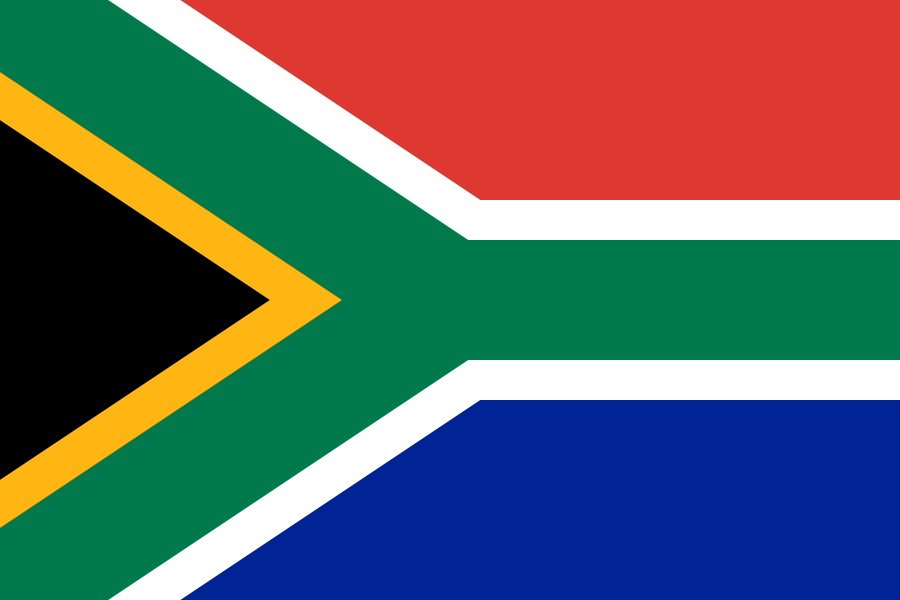
- description: two equal-width horizontal bands of red (top) and blue separated by a central green band that splits into a horizontal Y; a black isosceles triangle is in the Y, with narrow yellow bands around it; the red and blue bands are bordered by narrow white stripes
meaning: the colors have no official meaning, but the Y stands for "the convergence of diverse elements within South African society, taking the road ahead in unity"
note: South Africa has one of two national flags that display six colors as part of the primary design -- the other is South Sudan's - National symbol(s)
- springbok (antelope), king protea flower
- National color(s)
- red, green, blue, yellow, black, white
- National anthem(s)
- title: "National Anthem of South Africa"lyrics/music: Enoch SONTONGA and Cornelius Jacob LANGENHOVEN/Enoch SONTONGA and Marthinus LOURENS de Villiershistory: adopted 1997; a combination of "N'kosi Sikelel' iAfrica" (God Bless Africa) and "Die Stem van Suid Afrika" (The Call of South Africa), which were respectively the anthems of the non-white and white communities under apartheid; official lyrics contain a mixture of Xhosa, Zulu, Sesotho, Afrikaans, and English (the five most widely spoken of South Africa's 11 official languages)
- National heritage
- total World Heritage Sites: 12 (7 cultural, 4 natural, 1 mixed)selected World Heritage Site locales: Fossil Hominid Sites of South Africa (c); iSimangaliso Wetland Park (n); Robben Island (c); Maloti-Drakensberg Park (m); Mapungubwe Cultural Landscape (c); Cape Floral Region Protected Areas (n); Vredefort Dome (n); Richtersveld Cultural and Botanical Landscape (c); Khomani Cultural Landscape (c); Barberton Makhonjwa Mountains (n); Human Rights, Liberation and Reconciliation: Nelson Mandela Legacy Sites (c); The Emergence of Modern Human Behaviour: The Pleistocene Occupation Sites of South Africa (c)
Economy 29 fields
- Economic overview
- upper-middle-income, largest southern African economy; Government of National Unity facing slow growth, fiscal gaps, and structural challenges; high income inequality, unemployment, and poverty; reforms to address electricity generation, transport, and logistics; leading producer and exporter of critical minerals
- Real GDP (purchasing power parity)
- Real GDP (purchasing power parity) 2024: $870.42 billion (2024 est.)Real GDP (purchasing power parity) 2023: $865.402 billion (2023 est.)Real GDP (purchasing power parity) 2022: $859.399 billion (2022 est.)
- Real GDP growth rate
- Real GDP growth rate 2024: 0.6% (2024 est.)Real GDP growth rate 2023: 0.7% (2023 est.)Real GDP growth rate 2022: 1.9% (2022 est.)
- Real GDP per capita
- Real GDP per capita 2024: $13,600 (2024 est.)Real GDP per capita 2023: $13,700 (2023 est.)Real GDP per capita 2022: $13,800 (2022 est.)
- GDP (official exchange rate)
- $400.261 billion (2024 est.)
note: data in current dollars at official exchange rate - Inflation rate (consumer prices)
- Inflation rate (consumer prices) 2024: 4.4% (2024 est.)Inflation rate (consumer prices) 2023: 6.1% (2023 est.)Inflation rate (consumer prices) 2022: 7% (2022 est.)
- GDP - composition, by sector of origin
- agriculture: 2.9% (2024 est.)industry: 24.4% (2024 est.)services: 62.7% (2024 est.)
- GDP - composition, by end use
- household consumption: 64.8% (2024 est.)government consumption: 19.2% (2024 est.)investment in fixed capital: 14.5% (2024 est.)investment in inventories: -0.6% (2024 est.)exports of goods and services: 31.8% (2024 est.)imports of goods and services: -29.9% (2024 est.)
- Agricultural products
- sugarcane, maize, milk, soybeans, potatoes, wheat, grapes, chicken, oranges, apples (2023)
note: top ten agricultural products based on tonnage - Industries
- mining (world's largest producer of platinum, gold, chromium), automobile assembly, metalworking, machinery, textiles, iron and steel, chemicals, fertilizer, foodstuffs, commercial ship repair
- Industrial production growth rate
- -0.4% (2024 est.)
note: annual % change in industrial value added based on constant local currency - Labor force
- 27.766 million (2024 est.)
note: number of people ages 15 or older who are employed or seeking work - Unemployment rate
- Unemployment rate 2024: 33.2% (2024 est.)Unemployment rate 2023: 32.1% (2023 est.)Unemployment rate 2022: 33.3% (2022 est.)
- Youth unemployment rate (ages 15-24)
- total: 60.9% (2024 est.)male: 57.1% (2024 est.)female: 65.5% (2024 est.)
- Average household expenditures
- on food: 16.1% of household expenditures (2023 est.)on alcohol and tobacco: 4.1% of household expenditures (2023 est.)
- Remittances
- Remittances 2024: 0.2% of GDP (2024 est.)Remittances 2023: 0.2% of GDP (2023 est.)Remittances 2022: 0.2% of GDP (2022 est.)
- Budget
- revenues: $123.263 billion (2022 est.)expenditures: $137.593 billion (2022 est.)
- Public debt
- Public debt 2022: 76.2% of GDP (2022 est.)
- Taxes and other revenues
- 26% (of GDP) (2022 est.)
note: central government tax revenue as a % of GDP - Current account balance
- Current account balance 2024: -$2.384 billion (2024 est.)Current account balance 2023: -$6.143 billion (2023 est.)Current account balance 2022: -$1.878 billion (2022 est.)
- Exports
- Exports 2024: $127.629 billion (2024 est.)Exports 2023: $124.671 billion (2023 est.)Exports 2022: $136.01 billion (2022 est.)
- Exports - partners
- China 19%, USA 8%, Germany 7%, India 7%, UK 6% (2023)
note: top five export partners based on percentage share of exports - Exports - commodities
- gold, platinum, coal, cars, iron ore (2023)
note: top five export commodities based on value in dollars - Imports
- Imports 2024: $119.59 billion (2024 est.)Imports 2023: $123.454 billion (2023 est.)Imports 2022: $127.669 billion (2022 est.)
- Imports - partners
- China 21%, India 7%, USA 7%, Germany 6%, UAE 4% (2023)
note: top five import partners based on percentage share of imports - Imports - commodities
- refined petroleum, crude petroleum, gold, cars, broadcasting equipment (2023)
note: top five import commodities based on value in dollars - Reserves of foreign exchange and gold
- Reserves of foreign exchange and gold 2024: $65.435 billion (2024 est.)Reserves of foreign exchange and gold 2023: $62.492 billion (2023 est.)Reserves of foreign exchange and gold 2022: $60.553 billion (2022 est.)
- Debt - external
- Debt - external 2023: $93.879 billion (2023 est.)
- Exchange rates
- Currency: rand (ZAR) per US dollar -Exchange rates 2024: 18.329 (2024 est.)Exchange rates 2023: 18.45 (2023 est.)Exchange rates 2022: 16.356 (2022 est.)Exchange rates 2021: 14.779 (2021 est.)Exchange rates 2020: 16.459 (2020 est.)
Energy 8 fields
- Electricity access
- electrification - total population: 86.5% (2022 est.)electrification - urban areas: 87.1%electrification - rural areas: 93.4%
- Electricity
- installed generating capacity: 65.989 million kW (2023 est.)consumption: 194.978 billion kWh (2023 est.)exports: 12.629 billion kWh (2023 est.)imports: 10.837 billion kWh (2023 est.)transmission/distribution losses: 22.838 billion kWh (2023 est.)
- Electricity generation sources
- fossil fuels: 87.3% of total installed capacity (2023 est.)nuclear: 3.7% of total installed capacity (2023 est.)solar: 2.9% of total installed capacity (2023 est.)wind: 5.3% of total installed capacity (2023 est.)hydroelectricity: 0.7% of total installed capacity (2023 est.)biomass and waste: 0.2% of total installed capacity (2023 est.)
- Nuclear energy
- Number of operational nuclear reactors: 2 (2025)Net capacity of operational nuclear reactors: 1.85GW (2025 est.)Percent of total electricity production: 4.4% (2023 est.)
- Coal
- production: 239.712 million metric tons (2023 est.)consumption: 176.095 million metric tons (2023 est.)exports: 66.918 million metric tons (2023 est.)imports: 3.301 million metric tons (2023 est.)proven reserves: 9.893 billion metric tons (2023 est.)
- Petroleum
- total petroleum production: 88,000 bbl/day (2023 est.)refined petroleum consumption: 609,000 bbl/day (2023 est.)crude oil estimated reserves: 15 million barrels (2021 est.)
- Natural gas
- production: 66.094 million cubic meters (2023 est.)consumption: 3.834 billion cubic meters (2023 est.)imports: 3.768 billion cubic meters (2023 est.)
- Energy consumption per capita
- Total energy consumption per capita 2023: 86.197 million Btu/person (2023 est.)
Communications 6 fields
- Telephones - fixed lines
- total subscriptions: 1.353 million (2023 est.)subscriptions per 100 inhabitants: 2 (2023 est.)
- Telephones - mobile cellular
- total subscriptions: 115 million (2024 est.)subscriptions per 100 inhabitants: 167 (2024 est.)
- Broadcast media
- the South African Broadcasting Corporation (SABC) operates 6 free-to-air TV stations; 1 private TV station; multiple subscription TV services with mix of local and international channels; mix of public and private radio stations at the national, regional, and local levels; state-owned SABC radio network has 18 stations, including one for each of the 11 official languages, 4 community stations, and 3 commercial stations; over 100 community stations with rural coverage
- Internet country code
- .za
- Internet users
- percent of population: 76% (2023 est.)
- Broadband - fixed subscriptions
- total: 2.15 million (2023 est.)subscriptions per 100 inhabitants: 3 (2023 est.)
Transportation 6 fields
- Civil aircraft registration country code prefix
- ZS
- Airports
- 573 (2025)
- Heliports
- 49 (2025)
- Railways
- total: 30,400 km (2021)standard gauge: 80 km (2021) 1.435-m gauge (80 km electrified)narrow gauge: 19,756 km (2014) 1.065-m gauge (8,271 km electrified)
- Merchant marine
- total: 110 (2023)by type: bulk carrier 3, general cargo 1, oil tanker 7, other 99
- Ports
- total ports: 8 (2024)large: 2medium: 4small: 1very small: 1ports with oil terminals: 7key ports: Cape Town, Durban, Mossel Bay, Port Elizabeth, Richards Bay, Saldanha Bay
Military and Security 7 fields
- Military and security forces
- South African National Defense Force (SANDF): South African Army (includes Reserve Force), South African Navy (SAN), South African Air Force (SAAF), South African Military Health Services
Ministry of Police: South African Police Service (SAPS) (2025) - Military expenditures
- Military Expenditures 2024: 0.7% of GDP (2024 est.)Military Expenditures 2023: 0.7% of GDP (2023 est.)Military Expenditures 2022: 0.8% of GDP (2022 est.)Military Expenditures 2021: 0.8% of GDP (2021 est.)Military Expenditures 2020: 1.1% of GDP (2020 est.)
- Military and security service personnel strengths
- approximately 65-70,000 active-duty National Defense Forces (2025)
- Military equipment inventories and acquisitions
- the SANDF's inventory is a mix of domestically produced and foreign-supplied equipment; South Africa's domestic defense industry produced most of the Army's major weapons systems (some were jointly produced with foreign companies), while the Air Force and Navy inventories include a mix of European, Israeli, and US origin armaments, alongside some domestic systems, such as combat helicopters and some naval vessels; South Africa has one of Africa's leading defense industries (2025)
- Military service age and obligation
- 18-22 (18-26 for college graduates) years of age for voluntary military service for men and women; initial 24-month service obligation (2025)
note: in 2023, women comprised nearly 30% of the military - Military deployments
- approximately 2,000 Democratic Republic of the Congo (MONUSCO and Southern African Development Community) (2025)
- Military - note
- the South African National Defense Force's (SANDF) primary responsibilities include territorial and maritime defense, supporting the Police Service, protecting key infrastructure, responding to disasters, and participating in international peacekeeping missions; border security and maintaining a rapid reaction capability for regional security missions and disaster response have been priorities; in recent years, it has been deployed internally to assist the Police with quelling unrest and assisting with border security; the SANDF also regularly participates in African and UN peacekeeping missions and is a member of the Southern Africa Development Community (SADC) Standby Force
the SANDF was created in 1994 to replace the South African Defense Force (SADF); the SANDF was opened to all South Africans who met military requirements, while the SADF was a mostly white force (only whites were subject to conscription) with non-whites only allowed to join in a voluntary capacity; the SANDF also absorbed members of the various anti-apartheid opposition groups, including the African National Congress, the Pan Africanist Congress, and the Inkatha Freedom Party, as well as the security forces of the formerly independent Bantustan homelands (2025)
Space 4 fields
- Space agency/agencies
- South African National Space Agency (SANSA; established 2010) (2025)
- Space launch site(s)
- Arniston launch facility (Western Cape) used to support space launch vehicle and ballistic missile program (1980s-1990s); it is now a weapons testing facility called the Denel Overberg Test Range (2024)
- Space program overview
- key areas of emphasis for its national space program include Earth observation/remote sensing (RS) capabilities, weather monitoring, research, engineering, and operations (tracking, telemetry, etc.); produces and operates satellites; has a sounding rocket program for carrying experimental payloads for research; cooperates with a range of foreign space agencies and industries, including those of China, France, India, Russia, and the US; member of the African Space Agency; participates in international programs such as the Square Kilometer Array Project; has a number of state- and privately-owned aerospace companies, as well as academic and research institutions involved in space-related activities (2025)
- Key space-program milestones
- 1976 - established a satellite remote sensing (RS)/radio astronomy center (originally built by the US in 1961 to receive data from US space missions)
1980s - conducted program to launch reconnaissance satellites on a domestically produced satellite launch vehicle (abandoned in 1994 along with nuclear program)
1999 - first domestically built RS/technology demonstrator microsatellite (Sunsat-1) launched by US
2009 - first government-owned and -operated RS/scientific/technology demonstrator satellite (SumbandilaSat) launched by Russia
2018 - inaugurated a radio space telescope array (Karoo Array Telescope or MeerKAT)
2021 - began construction of the international Square Kilometer Array radio telescope observatory; launched a sounding rocket for research purposes to an altitude of nearly 18,000 km (11,185 mi)
2022 - opened Africa's first regional space weather center
2023 - agreed to participate in China's international lunar research station project
Terrorism 1 field
- Terrorist group(s)
- Islamic State of Iraq and ash-Sham (ISIS)
note: details about the history, aims, leadership, organization, areas of operation, tactics, targets, weapons, size, and sources of support of the group(s) appear(s) in the Terrorism reference guide
Transnational Issues 3 fields
- Refugees and internally displaced persons
- refugees: 171,484 (2024 est.)IDPs: 7,385 (2024 est.)
- Trafficking in persons
- tier rating: Tier 2 Watch List — the government did not demonstrate overall increasing efforts to eliminate trafficking compared with the previous reporting period, therefore South Africa was downgraded to Tier 2 Watch List; for more details, go to: https://www.state.gov/reports/2025-trafficking-in-persons-report/south-africa/
- Illicit drugs
- USG identification:
major precursor-chemical producer (2025)
Frequently asked
- What is the population of South Africa in 2025?
- South Africa has a population of 64.75 million (64,747,319) according to World Bank, World Development Indicators data for 2025.
- What is the capital of South Africa?
- The capital of South Africa is Pretoria and Bloemfontein and Cape Town.
- How large is the economy of South Africa?
- South Africa's GDP is $427.18B (2025, World Bank, World Development Indicators), which is $6,598 per capita.
- Who leads South Africa?
- Head of state: Cyril Ramaphosa (since February 15, 2018). Source: Wikidata, checked August 11, 2026.
South Africa